By Aldridge Dzvene
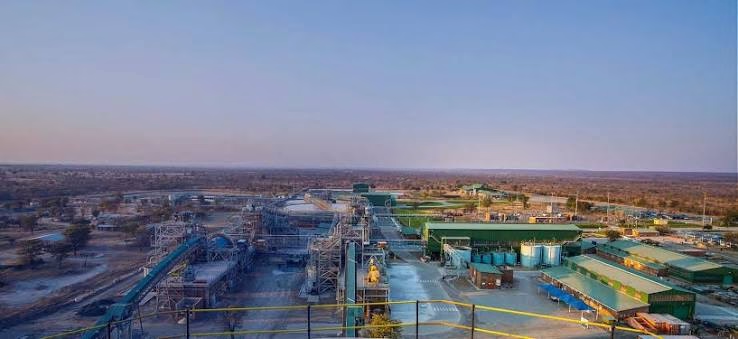
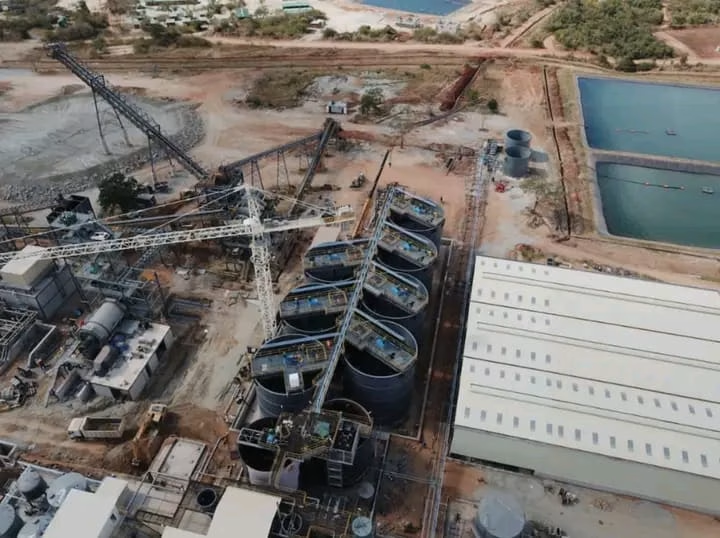
GURUVE — Eureka Gold Mine has produced more than seven tonnes of gold since its recommissioning by His Excellency Dr Emmerson Dambudzo Mnangagwa, President and First Secretary of ZANU PF, in 2021, with more than US$50 million invested in the revival and expansion of the operation, turning what was once a dormant mining asset into a major economic centre for Guruve and Mashonaland Central.
The significance of the Eureka story, however, goes beyond the seven-tonne production figure. The more important economic question is what happens when capital is injected into a previously inactive productive asset and that investment begins to generate employment, local business activity, infrastructure and additional productive capacity around it. In Guruve, the evidence is increasingly visible in the growth of the mine, the expansion of its workforce and the development of surrounding communities.
Eureka had remained largely inactive for almost two decades, with its pit flooded and processing infrastructure inactive, before Dallaglio Investments committed more than US$50 million towards its revival and expansion. That investment effectively shifted the mine from being a stranded asset into an operating industrial enterprise, demonstrating how the reactivation of existing mineral assets can create economic value without having to start an entirely new mining district from scratch.
The production trajectory provides another indication of that transformation. Eureka was producing about 92 kilogrammes of gold per month in September 2021, while monthly output had risen to 232 kilogrammes by August 2026. That represents a substantial increase in productive capacity over the five-year period and places the mine within the broader effort to expand Zimbabwe’s formal gold production base.
The employment numbers are equally important because they show how mineral production translates into a wider economic footprint. Eureka’s workforce grew from 418 employees during construction to 699 when production began and now stands at approximately 1 531 workers, making the mine the largest single private employer in Guruve District. The economic effect therefore extends beyond the gold recovered from the ore, creating household incomes, demand for goods and services and a larger local market around the mining operation.
This is where the Guruve experience becomes relevant to the wider debate around Zimbabwe’s mining sector. A mine’s contribution cannot be measured only by ounces or tonnes produced. Its deeper economic value can be assessed through the network that develops around production, including employment, procurement, contractors, transport, accommodation, skills development, infrastructure and community services. Where these linkages are strong, mining becomes an economic platform rather than an isolated extraction point.
Eureka’s community investments illustrate this broader model. The mine has supported schools, a clinic, housing and other infrastructure, while 53 families affected by mining operations have been relocated into modern houses. The company has also been involved in water infrastructure, including solar-powered boreholes serving communities and institutions in the district. These investments do not replace the responsibilities of the State or local authorities, but they demonstrate how a large industrial operation can become part of the infrastructure ecosystem of a rural economy.
The energy strategy is perhaps the clearest indication that the mine is now thinking beyond simply increasing gold output. Eureka experienced a prolonged power interruption in 2023 that affected profitability, prompting the company to invest in its own renewable-energy capacity. The first 5.4MW phase of a planned 16.2MW solar project has been completed, with the full installation expected to generate more power than the mine’s own consumption and potentially allow surplus electricity to enter the national grid.
That investment has implications beyond Eureka itself. Power availability remains a structural constraint for energy-intensive industries in Zimbabwe, meaning that a mining company investing in dedicated renewable generation is simultaneously protecting its own production and adding generation capacity to the wider economy. If the planned surplus is successfully exported to the grid, the project moves from being simply a mine-support initiative into a small but meaningful contribution to national energy security.
The figures also illustrate an important point about investment continuity. The US$50 million commitment did not produce its economic effect through a single expenditure. Its impact has unfolded through years of production, employment expansion, infrastructure development and further capital investment. This is why the Eureka example is better understood as a long-term productive investment story rather than simply a mining reopening story.
Zimbabwe’s gold sector itself is operating within an environment where production growth remains strategically important. Gold deliveries to Fidelity Gold Refiners reached 26.05 tonnes in the first seven months of 2026, with large-scale producers contributing 7.64 tonnes during that period, according to industry data. Eureka’s expanding production therefore forms part of a wider national effort to increase gold output and foreign-currency generation.
The larger lesson from Guruve is therefore about the relationship between capital, production and development. A dormant mine generates little economic activity; a functioning mine creates production; sustained production creates employment and markets; and reinvestment can then create infrastructure and additional productive capacity. The strength of that cycle ultimately determines whether mineral wealth produces a lasting local economic footprint.
Eureka’s more than seven tonnes of gold are consequently not just a production statistic. They are a measurable indicator of what has happened since capital returned to a previously inactive asset, while the expanding workforce, community infrastructure and renewable-energy investment provide a second layer of evidence about the economic ecosystem developing around the mine. The next measure of success will be whether that ecosystem continues to deepen through local procurement, skills development, downstream enterprise and further investment, allowing Guruve to capture a growing share of the value created by its mineral resources.