By Aldridge Dzvene
Zimbabwe’s Munhumutapa Day is ultimately not about remembering an empire.
It is about what Zimbabwe believes it can become.
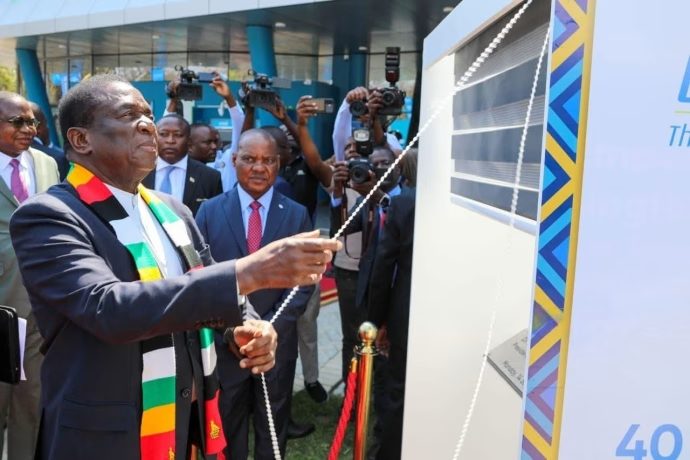
That is the deeper message emerging from President Emmerson Dambudzo Mnangagwa’s address at the inaugural Munhumutapa Day commemorations in Mashonaland Central, where history was deliberately connected to the economic ambitions, political sovereignty and generational responsibilities of contemporary Zimbabwe.
The speech did something more significant than celebrate a pre-colonial civilisation.
It attempted to establish a line of continuity between the Zimbabwe of Munhumutapa, the Zimbabwe born out of the liberation struggle and the Zimbabwe being constructed under Vision 2030.
The argument is simple but politically powerful.
Zimbabweans should not view themselves merely as inheritors of a difficult economic present. They should see themselves as descendants of a society that once organised itself, traded across borders, exploited its mineral wealth and built systems of governance long before colonial rule.
President Mnangagwa described the Munhumutapa Empire as possessing sophisticated organisational systems, economic agility, architectural prowess and extensive commercial networks, while highlighting its use of gold and copper in trade.
That historical reference matters because it changes the psychological starting point of the development conversation.
The question is no longer simply whether Zimbabwe can develop.
It becomes whether a country with such a deep history of organisation, production, trade and self-government can reproduce those qualities in a modern economy.
This is where Munhumutapa Day becomes an economic story.
The President’s speech repeatedly translated historical qualities into contemporary economic instructions. Courage becomes entrepreneurship. Innovation becomes technology and artificial intelligence. Ancient trading networks become regional integration and intra-African trade. Resource wealth becomes productive exploitation. Self-determination becomes economic sovereignty.
The past is therefore being presented not as a museum piece, but as a template.
That is perhaps the most important political meaning of the new holiday.
For the Second Republic, national identity and economic transformation are being placed in the same conversation.
The speech makes this especially clear through its treatment of young people.
Young Zimbabweans were not addressed primarily as a generation waiting for jobs to be created for them. They were challenged to become producers, entrepreneurs, farmers, industrialists, innovators and wealth creators.
The President pointed to youth agriculture schemes, mechanisation, housing and empowerment programmes, but immediately pushed the argument further, urging young people to participate in agricultural value chains and agro-industries and to use technology to transform raw production into processed products.
That is a significant shift in emphasis.
The central issue becomes productive capacity.
A country cannot achieve economic sovereignty simply because it owns resources. It needs the capacity to convert land into food, minerals into industrial value, ideas into businesses, technology into productivity and infrastructure into economic activity.
This is precisely why the President’s call for young people to “make money” carries greater significance than the phrase itself.
It is an argument against an economy built around consumption without sufficient production.
It is also an argument for a generation that measures patriotism not only through political loyalty, but through what it produces for the country.
The speech explicitly connects prosperity to hard, honest work, discipline and focus, while warning against corruption.
That creates the central contradiction that Munhumutapa Day now places before Zimbabwe.
The country has enormous historical confidence.
But historical confidence cannot feed a nation.
It cannot create exports.
It cannot build factories.
It cannot employ young people.
It cannot transform a mineral deposit into a sophisticated industrial economy.
Only production can do that.
And this is why the President’s reference to Artificial Intelligence is particularly revealing.
The Munhumutapa of the speech is not being imagined as an excuse to retreat into nostalgia. It is being used to argue that Zimbabweans have historically demonstrated the capacity to innovate and organise, and therefore must apply those attributes to the technologies and economic opportunities of the present.
The message is effectively that modernisation should not require Zimbabwe to abandon its identity.
Instead, identity is being used as the confidence base for modernisation.
There is also a geopolitical calculation embedded in the speech.
The President linked the Munhumutapa trading legacy with contemporary regional integration, Zimbabwe’s forthcoming COMESA chairmanship and its coming term as a non-permanent member of the United Nations Security Council. These platforms, he said, should be used to pursue markets, investment, partnerships and entrepreneurship opportunities.
This gives the historical narrative an outward economic direction.
Munhumutapa is being remembered as a trading civilisation, while modern Zimbabwe is being encouraged to think beyond its borders.
The message is not simply that Zimbabwe once possessed wealth.
It is that Zimbabwe once participated in regional and international commerce on its own terms, and that contemporary economic diplomacy should seek to recover that confidence.
That is also where the Second Republic’s sovereignty narrative intersects with its development agenda.
The speech repeatedly invokes independence, sovereignty, self-determination, unity and national ownership. At the same time, it calls for investment, trade, technology and international partnerships.
The underlying proposition is that openness to the world does not necessarily mean surrendering national agency.
Zimbabwe can trade, attract investment, participate in multilateral institutions and engage global technology while insisting that the strategic direction of development remains nationally owned.
This is captured in the Government’s formulation that Zimbabwe is “a friend to all and enemy to none”.
But perhaps the most important part of the speech is the challenge it gives to the youth.
The President warned against corruption, tribalism, regionalism, drugs, crime and violence, while calling on young people to pursue education, skills, productive work and community service.
That is not merely a social message.
It is an economic one.
A developmental state requires a productive population. Drug abuse reduces productivity. Corruption distorts capital allocation. Tribalism and regionalism weaken social cohesion. Crime undermines investment. A lack of skills limits industrialisation.
The speech therefore presents national character as an economic asset.
This may ultimately be the most consequential idea behind Munhumutapa Day.
Zimbabwe is not only being asked to remember who it was.
It is being asked to decide what kind of people it needs to become.
The historical Munhumutapa is presented as courageous, innovative, commercially sophisticated and self-determining. The contemporary Zimbabwean youth is being challenged to embody those same qualities through agriculture, mining, manufacturing, tourism, technology, entrepreneurship and innovation.
That is the bridge between the centuries.
And it creates a much higher standard for the holiday itself.
If Munhumutapa Day remains only a celebration, its meaning will eventually fade into ceremony.
But if the historical narrative becomes a catalyst for production, enterprise, technological innovation, regional trade and economic confidence, then the holiday will have achieved something much more consequential.
It will have turned history into an instrument of development.
The real test, therefore, will not be the size of the celebrations or the speeches delivered on September 15.
It will be what Zimbabwe’s young people build between one Munhumutapa Day and the next.
Because the ultimate way of honouring a civilisation remembered for trade, organisation, innovation and economic strength is not to simply speak about its achievements.
It is to produce new ones.
That is the deeper challenge now sitting at the heart of Munhumutapa Day.