By Aldridge Dzvene
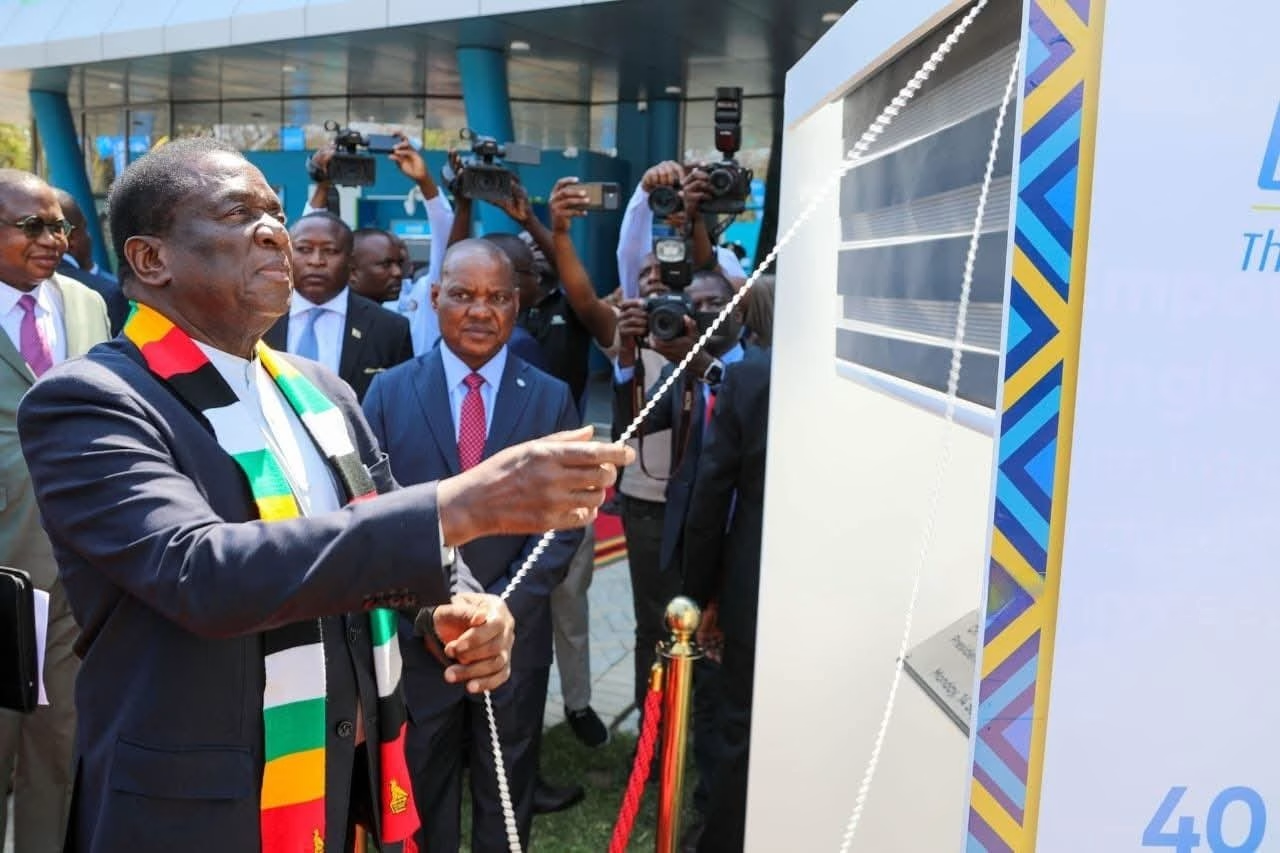
HARARE – The commissioning of Ecobank Zimbabwe’s new headquarters by His Excellency Dr Emmerson Dambudzo Mnangagwa, President of the Republic of Zimbabwe, has offered a useful measure of how Zimbabwe’s investment proposition is evolving, with the country increasingly seeking not simply to attract financial institutions, but to position capital as an active participant in production, industrialisation and regional trade.
The significance of the new headquarters goes beyond the construction of another corporate building in Harare. President Mnangagwa used the occasion to place the investment within the broader economic architecture of the Second Republic, pointing to the project as evidence of investor confidence, local technical capacity and the country’s ambition to become a gateway to SADC and the wider African market.
The fact that the Ecobank Group’s first constructed and owned head office in the Southern Africa region is in Zimbabwe was highlighted by the President as an indication of confidence in the country as an investment destination. The timing was also significant, coinciding with Ecobank’s 40th anniversary as a Pan-African institution and reinforcing the strategic intersection between Zimbabwe’s economic ambitions and Africa’s expanding financial integration.
But perhaps the most important message from the commissioning was not about the building itself. It was about who built it.
President Mnangagwa specifically commended the Zimbabwean architects, engineers, project managers and construction teams involved in delivering the facility, arguing that the project demonstrates that local skills can deliver infrastructure to global standards. His formulation, “Nyika inovakwa, inotongwa, inonamatigwa nevene vayo,” placed local ownership and capability at the centre of the investment story.
That is an important distinction for Zimbabwe’s development trajectory. Foreign investment can provide capital, technology and market access, but sustainable transformation requires domestic capabilities capable of absorbing and multiplying those benefits. The Ecobank project therefore becomes significant not only because capital has entered Zimbabwe, but because Zimbabwean professionals and companies have participated in converting that capital into a physical national asset.
The building’s sustainability features add another dimension. Solar-control glazing, rainwater harvesting and energy-efficient systems were incorporated into its design, with the facility endorsed by the International Finance Corporation and certified under the Excellence in Design for Greater Efficiencies framework. President Mnangagwa linked these features to National Development Strategy 2, particularly the need for modern infrastructure that reduces environmental impact and operating costs while improving efficiency.
For the financial sector, however, the larger test begins after the ribbon-cutting.
A modern headquarters does not automatically produce economic transformation. The institution occupying it has to channel financial resources towards productive sectors, facilitate investment and help businesses move from survival to expansion. This explains the President’s emphasis on prudent lending, ethical management, fair practices and financial innovation.
Zimbabwe’s productive sectors, particularly agriculture and mining, require financial institutions capable of understanding long-term investment cycles and structuring capital around production rather than simply consumption. Value addition and beneficiation similarly require patient capital, trade finance, technology financing and access to markets.
This is where Ecobank’s Pan-African footprint becomes strategically relevant.
Zimbabwe’s ambition to strengthen its position as a gateway to SADC and the wider continent will depend partly on the efficiency with which money, goods and businesses can move across borders. Cross-border payments, trade finance and market linkages are therefore not peripheral banking services. They are part of the infrastructure of regional commerce.
The President’s challenge to Ecobank and other financial institutions to think beyond conventional banking reflects this emerging requirement. Africa’s economic integration cannot be achieved only through political declarations or physical infrastructure. It also requires financial systems capable of connecting producers in one market with customers, suppliers, investors and partners in another.
The bank’s financial inclusion initiatives targeting women and youth-led businesses fit into the same equation. Access to capital, mentorship and business networks can determine whether an entrepreneur remains a small informal operator or develops into a formal enterprise capable of entering larger domestic and international value chains.
This is particularly important because Zimbabwe’s next phase of economic transformation will require a much wider base of productive businesses. Large corporations remain important, but industrialisation cannot be sustained without smaller enterprises becoming suppliers, manufacturers, service providers and exporters within increasingly sophisticated value chains.
Ecobank’s repeated recognition as Zimbabwe’s Top Bank since 2021, including the 2025 award cited by the President, was presented as evidence of the institution’s established footprint across the economy. The challenge now is to convert that institutional strength into deeper developmental impact, particularly through financing that supports production, technology, exports, infrastructure and enterprise expansion.
The President’s declaration that “Ecobank is Open for Business” consequently carries an interesting strategic symmetry with the Second Republic’s original “Zimbabwe is Open for Business” proposition. The first message was directed largely at investors and the international market. The second suggests a reciprocal relationship, where institutions operating in Zimbabwe are expected to open their capital, products, expertise and networks to the country’s productive ambitions.
That is where the investment story becomes more consequential.
Zimbabwe does not only need more money entering the economy. It needs capital that circulates through agriculture, mining, manufacturing, technology, infrastructure and trade, creating multiple layers of economic activity before returning as stronger productive capacity. The quality of investment therefore matters as much as its volume.
The Ecobank headquarters is a physical symbol of confidence, but its deeper value will ultimately be measured through what happens beyond its walls: how many productive businesses gain access to finance, how much trade is facilitated, how many enterprises enter regional markets, how effectively digital banking expands inclusion and how much capital reaches sectors capable of generating sustainable economic growth.
The commissioning therefore marks more than the opening of a corporate headquarters. It presents a test of the next stage of Zimbabwe’s investment narrative, moving from being open to capital towards ensuring that capital becomes productive.
That is the harder part of the journey, and potentially the more important one.
Zimbabwe is seeking investment, but increasingly the question is what that investment does for Zimbabwe.
If the answer is production, enterprise, technology, regional trade, jobs and stronger Zimbabwean participation in global value chains, then the new Ecobank headquarters will represent more than a successful property investment. It will stand as part of the financial infrastructure supporting the country’s transition towards the industrialised and prosperous economy envisaged under Vision 2030.