By Aldridge Dzvene
HARARE — President and First Secretary of ZANU PF, His Excellency Cde Dr Emmerson D. Mnangagwa, has sharpened the ruling party’s development mandate by placing the material improvement of citizens’ lives at the centre of political organisation, Government implementation and grassroots engagement, signalling that the credibility of the Second Republic’s programme will increasingly be judged through delivery rather than policy declarations.
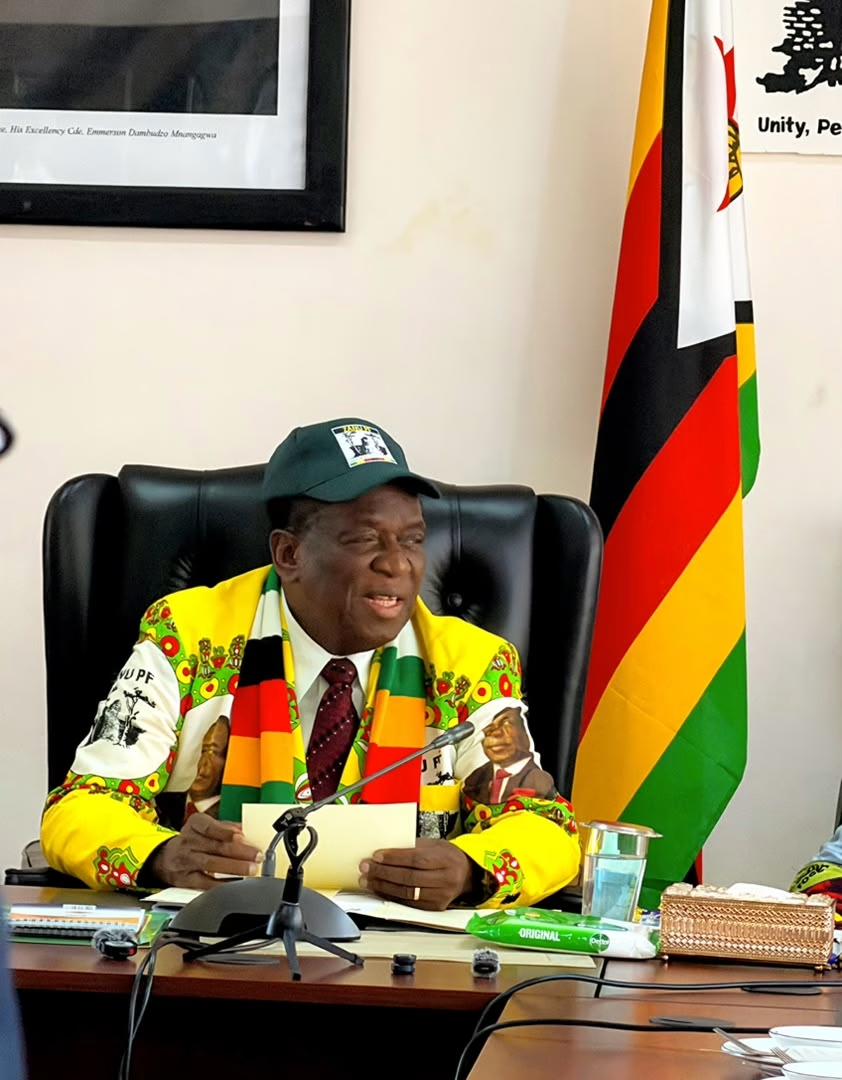
Chairing the 396th Ordinary Session of the ZANU PF Politburo at the Party Headquarters in Harare, President Mnangagwa directed Party and Government structures to ensure that national programmes remain “people-centred, practical, developmental and impactful”.
“The true measure of our work is the improvement in the livelihoods of our people in communities, in towns, and in rural areas,” the President said.
The significance of the message lies in where the President has placed the measure of political performance.
Rather than treating development as a separate administrative function of Government, the message effectively places development at the heart of the governing party’s political mandate. ZANU PF’s policies are expected to travel through Government institutions and ultimately return to the political leadership in the form of measurable outcomes within communities.
That creates a direct chain between political policy, Government implementation and citizen experience.
It also changes the nature of the political question surrounding Vision 2030. The issue is no longer simply whether Zimbabwe has articulated an ambitious development trajectory, but whether the institutions responsible for implementing that trajectory are capable of consistently translating national objectives into local economic and social outcomes.
This is why President Mnangagwa’s renewed emphasis on grassroots structures is particularly significant.
The ward and district are where national development meets the everyday realities of citizens. It is at this level that questions of food security, employment, roads, housing, water, public services and economic opportunities cease to be policy concepts and become lived experiences.
By directing Party structures to remain connected to communities, the President is effectively strengthening the feedback loop between the political leadership and the population.
That feedback is strategically important.
A national programme may appear successful when viewed through aggregate figures, completed projects or budget allocations, yet produce different experiences across communities. Political structures operating close to the population can identify these differences, communicate Government interventions and relay concerns about implementation.
The political value of such a system is therefore not merely communication.
It is intelligence about the effectiveness of policy at community level.
The emphasis on unity and discipline within Party structures must similarly be understood within this development framework. A governing party requires organisational coherence if its policy direction is to be communicated consistently and translated into coordinated Government action.
Fragmentation between political structures, Government departments and local institutions can create a gap between what leadership intends and what citizens eventually experience.
President Mnangagwa’s call for stronger grassroots structures therefore reinforces the need for political organisation to function alongside, rather than separately from, the national development programme.
This becomes increasingly important as Zimbabwe moves from NDS1 towards the next phase of the national development agenda.
NDS1 provided the broad policy architecture for stabilisation, infrastructure development, food and nutrition security, human capital development and economic transformation. The next phase carries the additional burden of demonstrating continuity while deepening those gains.
The political challenge is consequently becoming one of conversion.
Policies must be converted into programmes. Programmes must be converted into projects. Projects must be converted into productive capacity. And productive capacity must ultimately translate into better livelihoods.
That chain is where political credibility is either strengthened or weakened.
A new road matters because it connects people and markets. An agricultural intervention matters because it raises production and strengthens household food security. Industrial investment matters because it creates jobs and expands domestic production. Improved services matter because they reduce the economic and social burden carried by communities.
Development therefore becomes politically meaningful when its effects can be identified beyond official statements.
The President’s formulation of people-centred development also places an important responsibility on Government officials.
If citizens are to be the ultimate measure of performance, then implementation cannot be assessed solely by whether funds were released, contracts awarded or projects commissioned. The more meaningful questions concern utilisation, accessibility, sustainability and economic impact.
A completed project that fails to serve its intended community does not fully satisfy a people-centred development model.
This is where political oversight becomes important.
ZANU PF’s grassroots structures have the potential to serve as an additional channel through which implementation experiences can be understood. Their effectiveness, however, depends on whether community feedback is genuinely captured, transmitted and acted upon.
The strength of the system will therefore depend not merely on having structures in place, but on whether those structures can identify emerging problems and connect them to the institutions capable of resolving them.
There is also a broader political-economic calculation.
The Second Republic has framed Vision 2030 around the transformation of Zimbabwe into an upper-middle-income economy. Such transformation requires more than macroeconomic indicators. It requires expanding productive capacity and ensuring that economic growth reaches communities.
This places employment, agricultural productivity, industrialisation, infrastructure and service delivery at the centre of the political development equation.
For ZANU PF, this means the development agenda is increasingly inseparable from its organisational agenda.
The Party must remain capable of explaining what Government is doing, understanding what communities require and maintaining political coherence around the national development programme. Government, on the other hand, must demonstrate the capacity to implement those priorities efficiently and produce measurable outcomes.
The relationship is therefore reciprocal.
Political direction without implementation produces frustration. Government implementation without effective political communication can leave communities disconnected from the broader development narrative. Grassroots structures without meaningful feedback mechanisms risk becoming purely organisational.
The President’s message at the 396th Politburo session speaks directly to closing these gaps.
It is also significant that the call for people-centred development comes with an emphasis on unity and discipline. Development requires continuity, and continuity requires institutions that can execute policy beyond individual announcements and political cycles.
The broader objective is to make Vision 2030 visible at community level.
That means the success of the development agenda will increasingly be determined by whether citizens in towns, cities, growth points and rural areas can identify concrete changes in their economic circumstances.
The 396th Politburo session therefore represents more than another review of Party programmes.
It reinforces a political doctrine in which development delivery becomes a principal measure of the governing party’s effectiveness.
The deeper message is that political leadership must ultimately demonstrate its relevance through results.
As Zimbabwe advances towards the next stage of its national development strategy, the most consequential contest will not be over who can produce the strongest policy language. It will be over who can close the distance between policy and the people.
President Mnangagwa has placed that responsibility squarely before Party and Government structures.
The measure of the political programme, ultimately, is no longer what is promised at the centre, but what changes at the periphery.