Delta Corporation Limited has opened the 2026 financial year with strong trading momentum, underpinned by a stable operating environment, firm consumer demand and double-digit volume growth across its core beverage categories.
For the first quarter ended 30 June 2026, Group beverage volume rose by 14% to approximately 3.4 million hectolitres, with Zimbabwe operations excluding regional subsidiaries growing 18%. Revenue increased 23% to US$294.6 million from US$238.6 million in the prior-year quarter, supported by robust volume growth, improved sales mix and limited pricing adjustments in sparkling beverages. More than 90% of domestic sales continued to be conducted in foreign currency, reflecting the sustained dollarisation of the economy.
Lager beer volume grew 17% compared to the prior-year quarter, with growth broad-based across mainstream brands and supported by improved availability of local premium brands such as Zambezi. Premium global brands and flavoured alcoholic beverages also recorded strong growth from a low base. Traditional sorghum beer in Zimbabwe delivered a 20% volume increase, led by Chibuku Super which grew 30%. The newly introduced Leopard Extra brand continued to gain trade acceptance as distribution was expanded.
In non-alcoholic beverages, the portfolio comprising sparkling drinks, Maheu and Schweppes grew volumes by 14%. Schweppes led with 37% growth on the back of restored packaging lines and improved supply, while sparkling beverages grew 7% despite VAT and cost pressures. Maheu volumes were flat due to capacity constraints. African Distillers posted a 43% jump in wines and spirits volumes, with ready-to-drink up 48%, wines up 80% in the affordable segment, and spirits up 32%, led by Star Brandy.
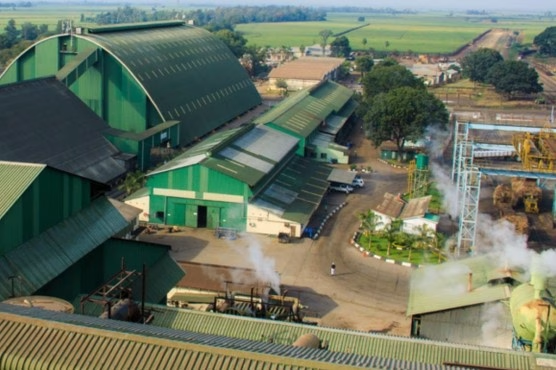
Demand continued to outpace production in several categories. In response, Delta is advancing a phased capacity-expansion programme. Upgrades at Southerton Brewery are expected to release additional throughput from the third quarter, ahead of the larger Belmont Brewery expansion where a replacement brewhouse and packaging line are in progress. Complementary investments in returnable glass, crates and logistics are also underway to close supply gaps by November 2026. African Distillers is investing in additional packaging capacity due for commissioning in the third quarter.
Barley supply through contract farming remains sufficient, with focus now shifting to aligning malting capacity with projected lager growth.
Regionally, performance was mixed. United National Breweries in South Africa recorded a 7% volume decline due to distributor changes, affordability pressures and community disruptions, but the new KwaZulu-Natal brewery is now operational and improving service levels. National Breweries Zambia saw volumes fall 12% on plant reliability and distribution constraints, though the improving macro environment with lower inflation and a firmer Kwacha provides support. Management’s focus is on stabilising production and rebuilding distribution in both markets.
The Zimbabwe trading environment remained steady, anchored by ZiG stability, low inflation and firm activity driven by mining, agriculture, tobacco liquidity and diaspora remittances. In South Africa, conditions improved gradually with a firmer Rand, while Zambia benefited from higher copper prices and better power supply. However, the Group absorbed higher costs from fuel, freight, PET packaging and geopolitical disruptions to shipping routes. It also accrued US$7.3 million in sugar tax during the quarter and continues to engage authorities on the regime. Delta paid US$88.5 million in current taxes in Zimbabwe, reaffirming its position as one of the largest contributors to the fiscus.
On tax disputes, ZIMRA has assessed approximately US$97 million in additional foreign-currency income tax and VAT for 2019 to 2024. Delta has paid US$20.8 million to date under “pay now, argue later” and holds US Dollar Treasury Bills for potential set-off. The matter remains before the courts, with management pursuing an amicable resolution. A similar transfer-pricing assessment is being addressed in Zambia.
Delta enters the second quarter with strong momentum in Zimbabwe, supported by currency stability and firm demand. Priorities include completing capacity projects, protecting product availability, managing cost pressures, and advancing responsible-consumption and recycling programmes such as Pledge 18 and Make A Difference-Recycle. In the region, the focus is on rebuilding distribution at Natbrew Zambia and consolidating gains at UNB South Africa.
The Board noted that Nampak Zimbabwe, in which Delta holds a stake, continues to face challenges from high input costs and power interruptions, while its majority shareholder’s disposal process remains ongoing.