Caledonia Mining Corporation Plc has announced a significant discovery at its Blanket Mine in Zimbabwe, where surface drilling has defined a previously unrecognised gold zone containing both oxide and sulphide mineralisation.
The results from the K-Pits target area within the Blanket mining lease point to the potential for low-cost heap leach operations and may represent a new orebody that has not been exploited by historic underground mining.
Surface reverse circulation drilling confirmed continuity of gold mineralisation from surface. Highlights include 23.00 metres grading 2.61g/t from surface in hole KPT0EX2553, 15.00 metres at 1.69g/t from surface in hole KPT0EX2545, and 6.00 metres at 1.97g/t from 14 metres in hole KPT0EX2561 within the oxide zone. Transitional mineralisation was intersected with 20.00 metres at 1.22g/t from 19 metres in KPT0EX2567 and 12.00 metres at 1.20g/t from 23 metres in KPT0EX25124. In sulphide, the drilling returned 16.00 metres at 6.04g/t from 29 metres in KPT0EX2510, 7.00 metres at 5.96g/t from 13 metres in KPT0EX2542, and 5.00 metres at 3.96g/t from 40 metres in KPT0EX2576. All reported intersections are downhole and estimated true widths will be provided in the full tables accompanying the release.
The K-Pits programme was originally designed to evaluate near-surface targets within the Blanket lease that had received limited exploration attention. Trenching and RC drilling confirmed gold mineralisation associated with shear structures and lithological contacts within the Banded Iron Formation. Geological interpretation suggests the mineralisation lies approximately 200 metres east of the nearest projected underground orebody at Blanket, indicating that K-Pits could represent a separate mineralised horizon not accessed by existing underground workings.
The presence of near-surface oxide material is particularly significant because it may be amenable to conventional heap leach processing. Caledonia has commenced metallurgical test work to assess recovery and preliminary results are described as encouraging. Should test work confirm acceptable recoveries, the company intends to commence a trial heap leach operation on an initial 10,000 tonnes of material during the second half of 2026. Such a development could provide a lower-cost route to gold production to complement Blanket’s existing underground operations.
Work is well advanced on an updated resource statement for Blanket which will incorporate results from this surface programme alongside recent underground drilling. Caledonia expects to publish the updated statement in August 2026. Follow-up drilling is also planned from both surface and underground platforms to test potential extensions of the mineralisation at depth. The 2025 programme at K-Pits comprised 2,304.1 metres of trenching across 13 trenches and 7,063 metres of shallow RC drilling in 155 holes.
Commenting on the results, Chief Executive Officer Mark Learmonth said the discovery further demonstrates the significant exploration potential within the mining area and that a low-cost processing route for near-surface mineralisation could unlock additional value.
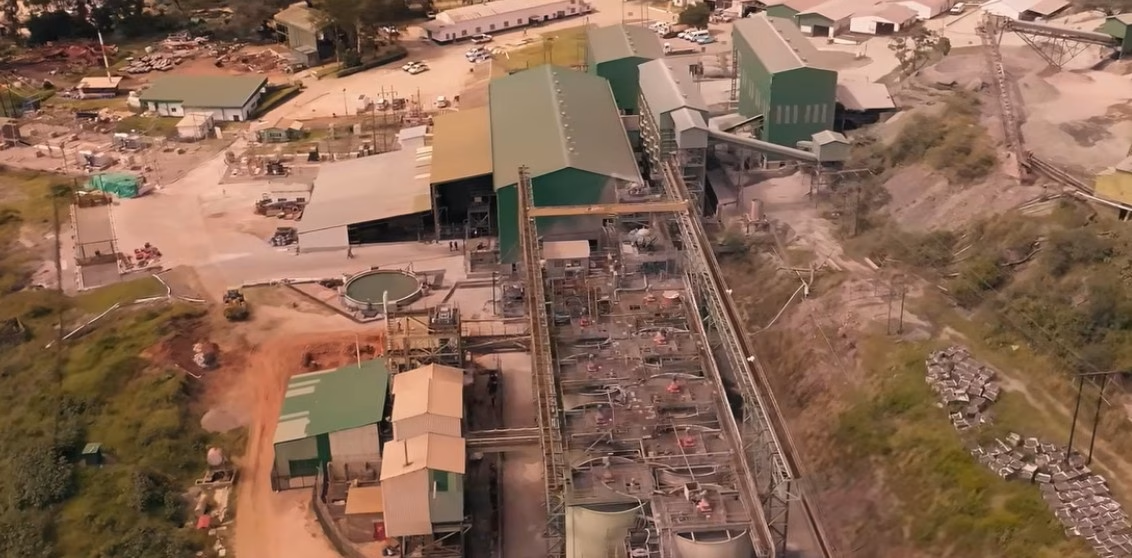
Blanket Mine is located 15km northwest of Gwanda in Matabeleland South, Zimbabwe, on the north-western limb of the Archaean Gwanda Greenstone Belt. Caledonia also holds the Bilboes development project and the Motapa exploration property to the north.