By Aldridge Dzvene
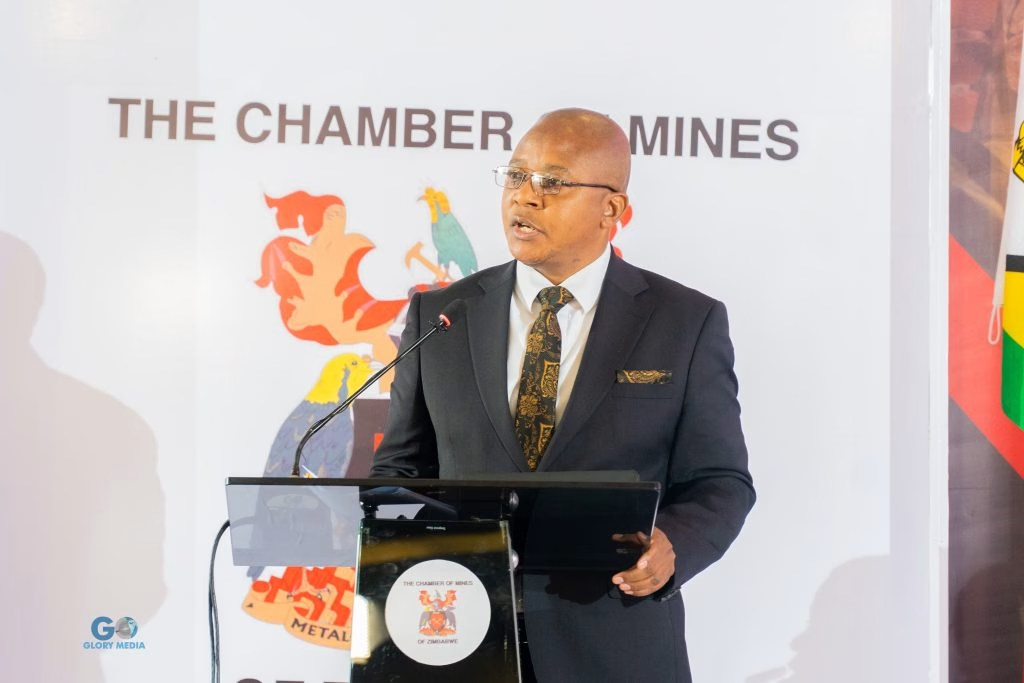
VICTORIA FALLS – Beneath the presentations, exhibitions and networking engagements that characterised this year’s Chamber of Mines Annual Mining Conference in Victoria Falls, a more profound message emerged from the keynote address delivered by Mines and Mining Development Minister Dr. Polite Kambamura.
Far from being a routine policy statement, the Minister’s address offered what many industry observers may interpret as a strategic blueprint for the future direction of Zimbabwe’s mining sector. It revealed a Government increasingly focused on value addition, industrialisation, technological innovation and strategic participation in global mineral supply chains.
At the centre of the Minister’s address was a fundamental question confronting many resource-rich nations: how can mineral wealth be transformed into sustainable economic development?
Historically, many African economies have exported raw minerals while importing finished products at considerably higher values. While such a model generates export revenue, it often leaves much of the economic value, industrial activity and job creation taking place outside the producing country.
Dr. Kambamura’s remarks suggested that Zimbabwe is seeking to break from this pattern.
His emphasis on beneficiation and value addition signalled a policy direction that views mining not merely as an extractive industry but as a catalyst for broader industrial development. In this regard, the Minister’s comments on lithium were particularly significant.
Zimbabwe has rapidly established itself as one of the world’s key lithium producers, attracting substantial investment as global demand for battery minerals continues to grow. However, the Minister made it clear that the country’s ambitions extend beyond exporting raw lithium ore. The focus is increasingly shifting towards higher-value products such as lithium sulphate and lithium carbonate, which command greater returns and create opportunities for downstream industrial activity.
The recent export of battery-grade lithium sulphate by a local producer was cited as evidence that Zimbabwe is capable of moving up the value chain. For policymakers and investors alike, this represents more than a mining achievement. It reflects the possibility of building new industries around mineral processing, engineering services, specialised manufacturing and advanced technologies.
Equally noteworthy was the Minister’s strong focus on mining efficiency and technology. His references to artificial intelligence, predictive analytics, robotics and automation demonstrated an appreciation of trends that are rapidly transforming the global mining industry.
As mining companies around the world adopt digital technologies to improve productivity, reduce costs and enhance safety, Zimbabwe appears determined to position itself within this evolving landscape. The message was clear: future competitiveness will depend not only on the quality of mineral deposits but also on the sophistication of the technologies used to extract and process them.
Another important dimension of the Minister’s address related to the changing geopolitical significance of critical minerals. Lithium, nickel, platinum, graphite and rare earth elements have become central to the global energy transition, powering electric vehicles, renewable energy systems and advanced manufacturing industries.
This growing demand has elevated minerals from ordinary commodities to strategic resources.
Zimbabwe’s substantial endowment of critical minerals places it in a favourable position within these emerging global supply chains. However, Dr. Kambamura emphasised that the country does not intend to remain merely a supplier of raw materials. Instead, Zimbabwe seeks to participate more actively in value creation and industrial development associated with these resources.
The Minister’s remarks also highlighted the continued importance of gold to Zimbabwe’s mining economy. Despite growing international attention on lithium and other critical minerals, gold remains one of the country’s most important foreign currency earners.
Particularly significant was his acknowledgement of the contribution made by artisanal and small-scale miners. Their role in national gold production continues to grow, supporting livelihoods and economic activity in many communities. At the same time, the Minister reiterated the need to curb mineral leakages and smuggling, noting that such practices deprive the country of revenue, investment opportunities and industrial benefits.
Beyond immediate production targets, the address also focused on the future sustainability of the sector. The proposed national airborne geophysical survey emerged as one of the most strategic initiatives outlined during the conference.
Modern geological exploration remains the foundation of future mining investment. By improving geological data and identifying previously undiscovered mineral deposits, the survey has the potential to attract exploration capital, expand resource inventories and support long-term growth within the industry.
Viewed collectively, the Minister’s address outlined a vision in which mining becomes a platform for broader economic transformation rather than a standalone export sector. Beneficiation, technology adoption, exploration, skills development, infrastructure investment and energy security all featured as interconnected pillars of this vision.
The significance of this approach extends beyond mining itself. If successfully implemented, it could strengthen industrialisation, stimulate job creation, increase export earnings, enhance technological capabilities and support Zimbabwe’s broader development objectives under Vision 2030.
What emerged from Victoria Falls was therefore more than a discussion about minerals. It was an articulation of how Zimbabwe intends to position itself in an increasingly competitive global economy where control of mineral value chains is becoming as important as ownership of the resources themselves.
The message from the conference was unmistakable: Zimbabwe’s future mining success will not be measured solely by the volume of minerals extracted from the ground, but by the value, industries and opportunities created from those resources within the country.