By Aldridge Dzvene
The presentation of findings by the Commission of Inquiry into the Sale of State Land in and Around Urban Areas since 2005 remains one of the most revealing assessments of Zimbabwe’s urban governance system, exposing how corruption, weak institutions, political interference, and poor planning combined to create a housing and infrastructure crisis whose effects continue to shape the country’s urban landscape today.
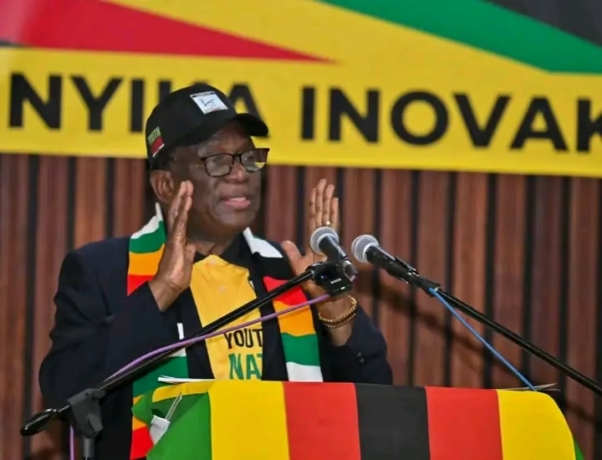
The Commission, chaired by Justice Tendai Uchena, presented its findings to His Excellency President Emmerson Dambudzo Mnangagwa in December 2019, outlining a deeply concerning picture of how urban state land was illegally allocated, sold, and occupied across Zimbabwe. The inquiry uncovered extensive irregularities involving local authorities, cooperatives, developers, politically connected individuals, and public officials, resulting in massive financial prejudice to the State and the emergence of settlements lacking even the most basic infrastructure.
Beyond the statistics and legal findings, the report reflected a broader governance challenge, showing how urban expansion in Zimbabwe evolved without proper coordination, strategic planning, or institutional accountability. The inquiry revealed that urban development occurred on at least 170 farms and state land units in and around urban areas, many of which had either not been formally handed over for urban development or were occupied before proper procedures had been completed.
What emerged from the findings was not merely a land administration issue, but a structural crisis touching on public administration, public health, housing delivery, infrastructure financing, and national development. The Commission highlighted that thousands of people were living in settlements without potable water, proper sewer systems, roads, or social amenities. This exposed residents to disease outbreaks and deteriorating living standards, while simultaneously undermining orderly urban growth.
The findings demonstrated how the demand for housing, coupled with weak institutional systems, created fertile ground for land barons and illegal settlement schemes. Individuals and groups took advantage of desperate home seekers, selling state land illegally while pocketing proceeds without developing infrastructure. In some instances, aspiring and sitting Members of Parliament allegedly facilitated new settlements as a means of mobilising political support, exposing how political influence became intertwined with urban land allocation.
The report also highlighted the dangerous consequences of parallel development policies, where beneficiaries were allowed to occupy and build houses before roads, sewer reticulation, water systems, and other essential infrastructure had been installed. While the policy may have been introduced to accelerate housing delivery, the Commission concluded that it instead contributed to chaotic settlements and unsustainable urbanisation.
One of the most alarming findings was the extent of financial prejudice suffered by the State. According to the Commission, government failed to recover billions of United States dollars in intrinsic land value from beneficiaries of urban state land. The report estimated that less than ten percent of the expected value had been recovered, leaving the State owed nearly three billion United States dollars.
This revelation exposed serious weaknesses in public financial management, valuation systems, and oversight mechanisms. The Commission found that some land was never properly valued before allocations and development took place. Poor record keeping, inadequate invoicing systems, and weak enforcement mechanisms further compounded the losses.
The implications of these findings extend far beyond financial losses. They point to the erosion of public trust in governance institutions and the weakening of systems meant to regulate land administration. When land allocation processes become vulnerable to corruption and political manipulation, confidence in public institutions declines, while genuine home seekers become victims of exploitation.
The inquiry also brought attention to the environmental and health risks created by unregulated settlements. Housing developments emerged on wetlands, under power lines, on top of sewer lines, and on land reserved for schools, clinics, and recreational facilities. In many communities, pit latrines were constructed close to water sources due to the absence of sewer systems, increasing the risk of cholera, typhoid, and other water borne diseases.
These findings reinforced the reality that urban planning is not simply about allocating land, but about protecting public health, preserving environmental sustainability, and ensuring long term economic productivity. Poorly planned settlements place enormous pressure on local authorities and national government, often requiring billions in future rehabilitation and infrastructure upgrades.
The Commission estimated that Zimbabwe would require more than two and a half billion United States dollars to address infrastructure deficits in roads, sewer systems, and water reticulation for urban settlements created since 2005. This figure highlighted the long term economic burden created by weak planning systems and irregular land administration.
Another significant dimension of the report was its exposure of institutional fragmentation. The Commission identified overlapping responsibilities between ministries, local authorities, and land administration bodies, which created loopholes exploited by corrupt actors. The absence of coordinated systems allowed unauthorised allocations, illegal transfers, and uncontrolled developments to flourish.
The recommendations presented by the Commission therefore focused heavily on institutional reform. The Ministry of Local Government was urged to suspend new allocations of unserviced urban land, tighten approval systems, review agreements with developers, and enforce payment of intrinsic land value. The Ministry responsible for Lands was advised to improve land records, exercise due diligence in issuing certificates, and avoid direct involvement in housing allocations.
The report also recommended specialised land courts, specialised police units, and stronger oversight structures to investigate and prosecute land related corruption. These proposals reflected recognition that conventional systems had become overwhelmed by the complexity and scale of urban land disputes.
Perhaps one of the most strategic recommendations was the proposal for the Office of the President and Cabinet to establish a special purpose vehicle dedicated to infrastructure development and urban settlement upgrading. The Commission argued that the magnitude of the crisis required a coordinated national response capable of mobilising technical expertise, financial resources, and institutional capacity.
The proposed special vehicle was envisioned as a temporary but highly focused mechanism to regularise settlements, improve infrastructure, strengthen urban management systems, and restore confidence in land administration processes. The recommendation acknowledged that local authorities alone lacked sufficient capacity to address the enormous infrastructure deficits created over years of uncontrolled urban expansion.
Importantly, the report also reflected broader socio economic realities affecting Zimbabwe. The rapid growth of informal settlements was partly driven by increasing urbanisation, housing shortages, unemployment, and economic pressures pushing citizens to seek affordable accommodation wherever land became available. In this context, land barons and illegal developers thrived because they appeared to offer solutions to desperate home seekers.
This means that addressing land corruption requires more than law enforcement. It demands comprehensive housing policies, affordable urban development models, accessible mortgage systems, and inclusive economic opportunities capable of reducing vulnerability among citizens.
The Commission’s findings therefore remain highly relevant in Zimbabwe’s ongoing development discourse. As the country pursues infrastructure modernisation, industrialisation, and urban transformation under Vision 2030, effective land administration and sustainable urban planning become critical pillars of national progress.
Urban land represents more than physical space, it is directly linked to economic growth, investment attraction, social stability, and public confidence in governance systems. Cities function as centres of commerce, innovation, and industrial activity, meaning that disorderly urban expansion undermines broader national development ambitions.
The inquiry also demonstrated the importance of accountability in public administration. The recommendation for further investigations into more than 400 cases signalled the need for stronger enforcement mechanisms and a culture of responsibility within institutions handling public land.
For Zimbabwe, the challenge moving forward lies in translating the Commission’s recommendations into tangible reforms capable of restoring order, transparency, and sustainability in urban development. Failure to address the underlying governance weaknesses risks perpetuating illegal settlements, infrastructure collapse, and recurring public health threats.
At the same time, the report provides an opportunity for policy renewal. By strengthening institutions, modernising land administration systems, improving urban planning frameworks, and insulating governance processes from corrupt influence, Zimbabwe can transform its urban centres into engines of sustainable development.
Justice Uchena’s presentation ultimately served as more than a legal or administrative exercise. It was a warning about the long term costs of institutional weakness and unregulated urban expansion, while also presenting a roadmap for reform, accountability, and sustainable national development.