While global funding for HIV and AIDS continues to shrink and many developing nations struggle to sustain life saving health programmes, Zimbabwe under the leadership of President Dr Emmerson Dambudzo Mnangagwa is recording one of the most decisive public health turnarounds on the African continent, a transformation driven not by donor dependence but by deliberate domestic investment and political will.
As the world marked World AIDS Day, Zimbabwe stood not as a victim of the epidemic but as a model of how national leadership can reverse a once devastating public health crisis into a story of resilience, self reliance and strategic governance. The country has now surpassed the global UNAIDS 95 95 95 targets, a benchmark that many nations are yet to achieve despite having far larger economies.
President Mnangagwa’s firm position on increasing domestic financing for health has quietly redefined Zimbabwe’s HIV response architecture. In a global environment where international health funding is increasingly uncertain and politically influenced, the Second Republic has shifted towards a home grown model that prioritises sustainability over short term dependence. This strategic recalibration has ensured the uninterrupted supply of life saving medicines, strengthened hospitals and laboratories and safeguarded community based prevention and treatment systems.
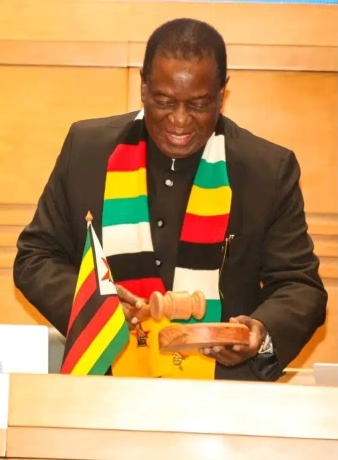
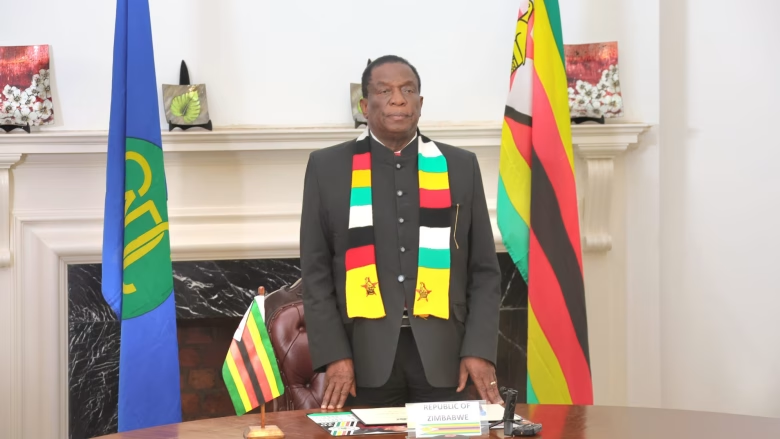
Speaking during the World AIDS Day commemorations on 30 November 2025, President Mnangagwa reaffirmed that the gains Zimbabwe has achieved must be protected through continuous national investment. This position is now backed by measurable outcomes that reflect one of the strongest HIV control systems in the region. Today, 97 percent of people living with HIV in Zimbabwe know their status, more than 95 percent are on antiretroviral therapy and 96 percent of those on treatment have achieved viral suppression, effectively cutting the risk of transmission and prolonging life expectancy.
Beyond the statistics lies a deeper governance story of institutional rebuilding, policy consistency and national ownership. Under the Second Republic, the fight against HIV and AIDS has moved from being a donor managed emergency response into a fully integrated public health programme anchored within the national health system. This structural shift is critical because it insulates Zimbabwe from external funding shocks and ensures continuity of care for millions who depend on the public health sector.
The economic implications of this success are equally profound. A healthier population translates into a more productive workforce, reduced health expenditure burdens on families and improved national development prospects. The President’s decision to prioritise domestic health financing is therefore not only a social policy intervention but a long term economic stabilisation strategy that directly feeds into Vision 2030.
President Mnangagwa has also been clear that while major progress has been achieved, vulnerabilities still persist among young people, women and key populations. The next phase of the HIV response now requires targeted prevention strategies, youth centred health education and expanded community outreach programmes to seal remaining transmission gaps. What is significant, however, is that Zimbabwe now faces these challenges from a position of strength rather than crisis.
The quiet strength of the Second Republic’s HIV response lies in its shift from survival mode to sustainability mode. At a time when many nations remain trapped in cycles of emergency funding and programme disruptions, Zimbabwe has demonstrated that political commitment, budget prioritisation and system strengthening can outperform donor dependency.
President Mnangagwa’s leadership in this sector has effectively turned HIV and AIDS from a national catastrophe into a controllable public health condition. The story unfolding is no longer one of despair but of policy clarity, institutional discipline and national resilience. It is a reminder that development victories are sometimes not announced with noise, but revealed through lives saved, families stabilised and a nation quietly regaining its future.