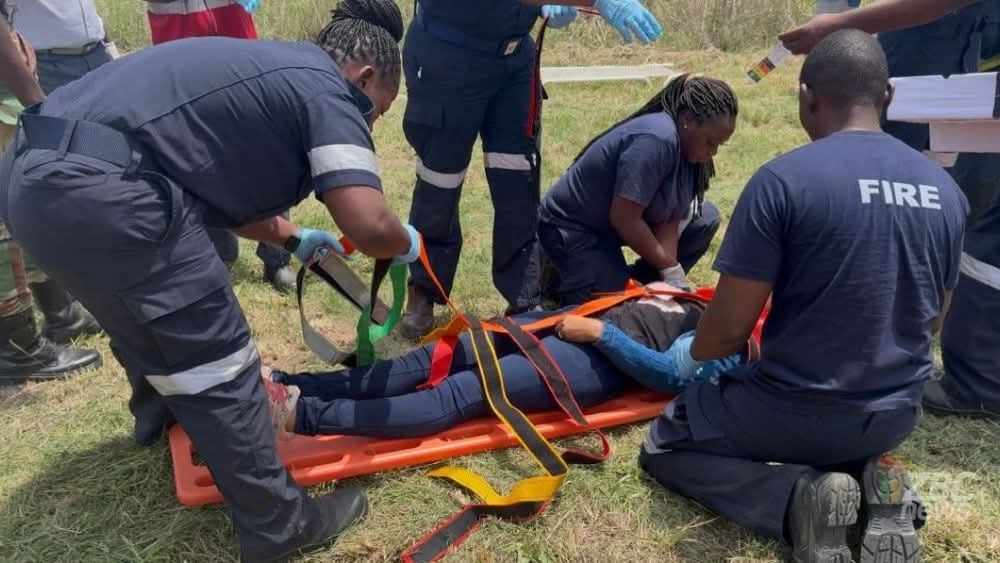
The Airports Company of Zimbabwe today turned land near Robert Gabriel Mugabe International Airport into a live test ground for crisis management, staging a full scale emergency response drill that moved the country’s aviation safety plans from paper to practice. In a tightly coordinated simulation of an aircraft crash, the Zimbabwe Republic Police, the Zimbabwe National Army, the Fire Brigade and Ambulance Services were all deployed, creating a controlled but realistic scenario to assess how well Zimbabwe can protect lives if disaster strikes near its busiest airport.
Beyond the flashing lights and sirens, the drill was a serious examination of how multiple agencies integrate under pressure. Aviation emergencies are by nature multi dimensional, no single institution can handle them alone. Police must secure the crash site, control crowds and preserve potential evidence, soldiers may be called in for logistics and perimeter control, firefighters battle flames and prevent fuel explosions, while ambulance teams focus on rapid triage and evacuation of the injured. ACZ sits at the centre of this web, responsible for activating the airport’s emergency plan, keeping runways and airspace safe and handling communications with airlines, regulators and families. Today’s simulation brought all these roles into one shared theatre, exposing how well each unit understands its mandate and how smoothly they transition from parallel operations to joint action.
Analytically, the exercise is significant on several fronts. First, it is a direct response to international aviation standards, which require airports to demonstrate that emergency plans are not theoretical documents but living systems regularly tested in drills. Regulators and global aviation bodies do not only ask whether an airport has an emergency manual, they interrogate whether personnel are trained, equipment is ready, communication channels are clear and agencies can execute under time pressure. By holding a visible drill near Robert Gabriel Mugabe International Airport, ACZ is signalling compliance with those global expectations and positioning Zimbabwe as a state that takes its safety obligations seriously.
Second, the drill functions as a real time audit of inter agency communication. In a genuine crash scenario, delays and miscommunication can cost lives. Radio frequencies must be compatible, chains of command must be unambiguous, and all responders must have access to the same operational picture. The exercise offers ACZ and its partners a chance to see where information bottlenecks arise, whether instructions are relayed clearly and how quickly decisions made at the command post translate into actions on the ground. These are details that cannot be fully assessed in a boardroom briefing, they only become visible when vehicles are moving, sirens are sounding and teams are responding as if every second counts.
Third, the operation is a barometer of resource readiness. The simulation pressures the system to answer hard questions, are there enough fire tenders and are they strategically positioned, is rescue equipment in good working condition, are ambulance teams adequately staffed and stocked, how long does it take for specialised units to arrive at the scene from the moment an alarm is raised. Any gaps exposed during the drill give ACZ and its partners actionable data for budget planning, training programmes and infrastructure upgrades before a real emergency forces those lessons in tragic circumstances.
For the travelling public and the aviation industry, the symbolism of the drill matters almost as much as the technical outcomes. Airports are gateways into a country, and perceptions of safety influence passenger confidence, airline decisions and insurance assessments. By choreographing a multi agency response in full view of stakeholders, ACZ is sending a message that Zimbabwe is not only interested in expanding routes and modernising terminals, but also in strengthening the invisible safety net that underpins every take off and landing. In a region where competition for traffic is intensifying, demonstrable commitment to safety becomes a strategic asset.
The exercise also has internal cultural value. Regular drills help normalise a mindset within ACZ and its partner agencies that preparedness is continuous rather than occasional. New staff members experience high pressure scenarios in a controlled way, seasoned personnel refresh their skills and commanders get to test leadership structures outside routine operations. Each drill becomes a rehearsal not just of procedures but of institutional discipline, reinforcing the idea that in aviation, complacency is itself a risk factor.
Ultimately, today’s emergency response drill near Robert Gabriel Mugabe International Airport underlines ACZ’s dual responsibility to both national and international audiences. Domestically, it reassures citizens that if an aviation accident occurs, the response will be organised rather than improvised. Internationally, it forms part of the evidence base that Zimbabwe can present to regulators, airlines and investors to show that it is serious about aligning with global aviation safety norms. The real measure of success will be seen in the debrief, where every delay, misstep or strength observed is recorded and fed back into improved procedures. But as an exercise in transparency and preparedness, the message is clear, ACZ is choosing to test its systems now so that, should the worst ever happen, Zimbabwe’s first response will be swift, coordinated and focused on saving lives.