

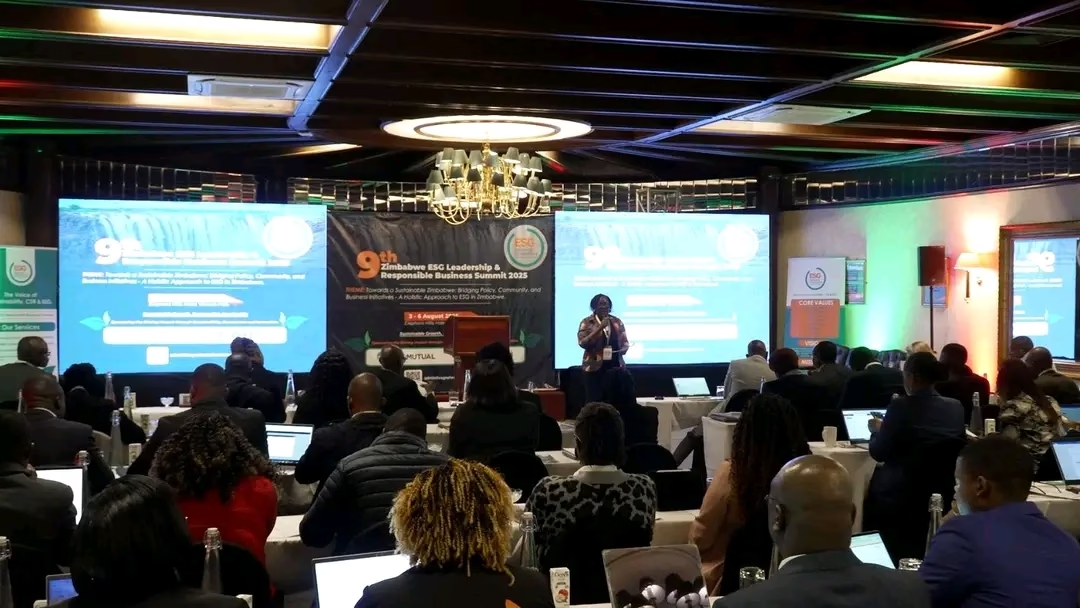
The opening of the Ninth Zimbabwe Environmental, Social, and Governance (ESG) Leadership and Business Summit in Victoria Falls marks more than just a convergence of public and private sector players. It signals a definitive turning point in Zimbabwe’s climate governance, as the state moves assertively to regulate a once shadowy carbon market, linking national development to global environmental accountability.
Until recently, carbon trading in Zimbabwe operated largely in the margins, unregulated, opaque, and offering limited returns to the nation. But the government’s twin interventions, the launch of a national carbon credit registry in 2024 and the gazetting of Statutory Instrument 48 in May 2025, have altered the terrain dramatically. The formalisation of this market is not only injecting transparency and confidence into an emerging sector, but it is also repositioning Zimbabwe as a serious player in the global carbon economy.
Speaking at the summit, Chief Director in the Ministry of Environment, Climate and Wildlife, Mr Washington Zhakata, revealed that six operational carbon projects are now in the process of regularising their trade. Notably, one advanced initiative has already placed over two million credits on the market. With credits selling between US$10 and US$15 apiece, the fiscal potential is real, and under the new regulatory model, Zimbabwe will directly receive 30% from each trade. This is a significant policy shift from past practices that often benefited foreign developers disproportionately.
Yet the real breakthrough here is not only economic. It is institutional. The government is reconfiguring environmental governance in a way that aligns with its broader developmental objectives. This is no longer just about reducing emissions; it is about building national resilience, boosting state revenue, empowering local communities, and asserting Zimbabwe’s climate sovereignty.
Equally compelling is the call for policy coherence. ESG Network Zimbabwe’s Executive Director, Mr Willard Razawo, praised the government’s legal reforms but warned of the fragmentation of sustainability laws. His advocacy for a harmonised national ESG framework reflects a maturing civic-private sector partnership and a recognition that true sustainability cannot be compartmentalised. If Zimbabwe is serious about Vision 2030 and the African Union’s Agenda 2063, it needs an integrated regulatory architecture that connects environmental stewardship with social justice and economic transformation.
This institutional maturation is already bearing fruit. As part of the reforms, a Loss and Damage Fund is being established to directly assist communities and municipalities whose infrastructure or livelihoods have been ravaged by climate-induced disasters. This is a progressive mechanism that mirrors global climate justice principles but localises the benefits.
The significance of hosting this summit, coming hot on the heels of COP15 of the Ramsar Convention, cannot be overstated. Victoria Falls is fast emerging as a diplomatic and policy hub for global environmental engagement, positioning Zimbabwe at the intersection of international best practice and homegrown innovation.
The ESG Leadership Summit’s emphasis on cross-sector collaboration is not incidental. It reflects a new consensus: climate governance is not the exclusive domain of environmentalists. It is a matter of corporate ethics, academic innovation, community resilience, and national interest. As climate change continues to redraw the boundaries of security, economy, and sovereignty, platforms like this summit are critical arenas for shaping Zimbabwe’s future.
With over 30 new carbon projects in the pipeline and institutional mechanisms beginning to take shape, the path ahead is promising, but fragile. What will determine the success of these reforms is not just regulation, but enforcement, capacity-building, and sustained political will.
In an increasingly carbon-conscious world, Zimbabwe’s efforts to bring legitimacy, transparency, and national gain to the carbon market may just be the strategic recalibration that turns environmental vulnerability into developmental opportunity.