

By Aldridge Dzvene | Positive Eye News
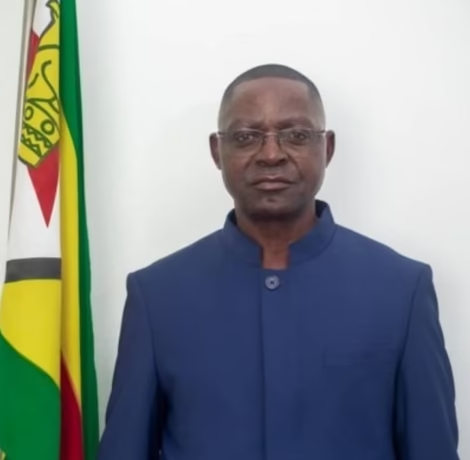
In what now feels less like a routine ministerial engagement and more like a decisive policy reset, Hon. Daniel Garwe’s meeting with the Harare City Council on Monday marked a critical turning point in the language of governance. Speaking from the City of Harare Headquarters, the Minister of Local Government and Public Works laid down an uncompromising message, Zimbabwe’s path to Vision 2030 will no longer be paved with tolerance for urban dysfunction.
Hon Garwe’s message was direct, structured, and unapologetic. Street vending in the Central Business District? Banned. Night vending? Shut down. Land barons? Declared enemies of development. In his own words, “There’s no room for compromise. No room for complacency. Vision 2030 will not be achieved by good intentions alone.” These remarks were not mere ministerial noise; they were a line in the sand, a political and administrative recalibration aimed at aligning Zimbabwe’s urban systems with the President’s developmental aspirations.
What makes Minister Garwe’s address particularly significant is that it went beyond vending. He connected urban disorder to deeper structural challenges, the breakdown of service delivery, the erosion of municipal authority, and the normalization of lawlessness. He argued that night vending had become a cover for drug and substance abuse, that informal setups were choking the city’s drainage systems, and that illegal settlements posed a serious threat to urban planning and public safety. The Minister’s framing positioned informality as a national risk rather than just an economic necessity.
But herein lies the paradox: vending and informal trade are not abstract problems, they are real survival tools for a struggling population. For many, vending is not a criminal act, but a lifeline. By declaring a blanket ban, government risks alienating the very people who make up the bulk of Zimbabwe’s informal economy. And while Garwe promised the establishment of modern markets to absorb displaced vendors, history has taught us that such plans often lag behind enforcement.
Nevertheless, the urgency in Garwe’s voice signaled that the time for soft politics is over. The government is no longer seeking to manage dysfunction, it is moving to eliminate it, even if that means confrontation with public sentiment. In this regard, Harare is being positioned as the litmus test of order under Vision 2030, a symbol of whether or not the Second Republic can modernize not just the economy, but the national psyche.
The meeting also dealt with infrastructural failure, particularly the recurrent issue of blocked and collapsing drainage systems. Garwe emphasized the importance of preemptive action ahead of the rainy season, challenging councils to adopt a proactive maintenance culture. “Let us not wait for emergencies to tackle these longstanding issues,” he said, a subtle dig at the culture of reactive governance that has come to define many local authorities.
In a noteworthy move, the Minister addressed the remuneration of councillors, highlighting a recently revised circular improving their allowances. But the subtext was clear: benefits must now come with performance. Councillors are expected to lead from the front, not just in form, but in function. In improving their conditions of service, the government is making a strategic investment, one that expects tangible returns in the form of better oversight, better planning, and better execution.
Minister Garwe also came down hard on land barons, labeling them as “undesirable elements” undermining legal settlement frameworks and distorting urban development. His tone suggested zero tolerance, a departure from previous years when such actors operated with near impunity. Whether this tough rhetoric will translate into legal and prosecutorial action remains to be seen. Still, the public declaration alone sends a powerful signal that land anarchy is no longer a tolerated practice under Vision 2030.
It is important to note that this meeting was not held in isolation. It was attended by Deputy Ministers B. Kabikira and A. Mavunga, Harare Mayor Jacob Mafume, and senior officials from government and council. The weight of the delegation added political gravity to the Minister’s message. It was not a conversation. It was a directive.
The broader takeaway from Garwe’s remarks is that President Mnangagwa’s Vision 2030 is entering a phase of execution, and with it, an expectation of discipline at every level. No longer satisfied with plans and promises, government is demanding results. And for Harare, a city that has long been held hostage by bureaucracy, factional politics, and infrastructural decay, this could be the beginning of a new urban doctrine: one that is focused, firm, and future-oriented.
But the success of this reset will depend on follow-through. Policies without action become political theatre. And while Garwe’s stance was bold and assertive, the real test lies ahead, in implementation, enforcement, and the balancing act between restoring order and protecting livelihoods.
In drawing this hard line, the Second Republic is making its priorities clear: urban chaos will not coexist with national vision. The question now is whether this hardline urban reset will build the strong, modern city the President envisions, or deepen the cracks in a society still struggling to stabilize itself.