By Aldridge Dzvene
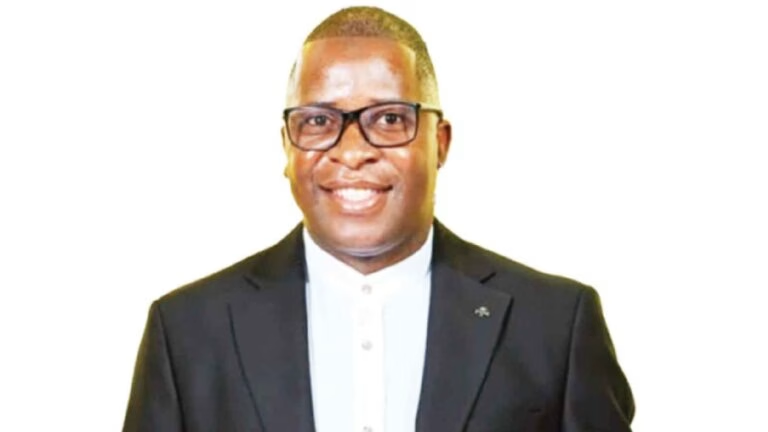
In the heart of Geneva, far from the rhythms of Harare, a Zimbabwean voice rose not in protest or plea, but with clarity, purpose and vision. When Speaker of Parliament Advocate Jacob Francis Mudenda addressed the 6th World Conference of Speakers of Parliament, he was not merely participating in another multilateral forum. He was redefining the posture of Zimbabwe’s Parliament in an era where legislative agility, digital literacy and diplomatic foresight are the currencies of global influence. At a time when the world appears gripped by polarising geopolitics, widening digital divides and sluggish multilateral institutions, Speaker Mudenda did not dwell on the dysfunction, but spoke instead from a place of optimism, boldly navigating a discourse that bridges old alliances and futuristic reforms.

Rainbow Hotels — Experience Luxury Across Zimbabwe
Rainbow Hotels continues to redefine hospitality standards in Zimbabwe, offering world-class accommodation, fine dining, and modern conference facilities in Harare, Bulawayo, and Victoria Falls.
Whether for business or leisure, Rainbow Hotels delivers unmatched comfort, exceptional service, and a truly premium guest experience tailored to modern travellers.
Book NowWhat stood out was not only his firm grasp of international law or his repeated emphasis on equitable cooperation, but his insistence on positioning Parliament as an agent of technological revolution. While others debated peace and justice in abstract, Speaker Mudenda was specific, calling for legislative frameworks that embrace Artificial Intelligence, digital inclusion and cybersecurity. He amplified the need for Parliamentarians to be proactive in harnessing AI for development, particularly in Africa, where technological transformation has long been hindered by low internet penetration, inconsistent power supply and underqualified legislators. Rather than masking these structural weaknesses, Speaker Mudenda addressed them head-on, proposing capacity-building initiatives and academic partnerships that would future-proof Zimbabwe’s legislative arm. It was within this context that he announced the establishment of the “Committee of the Future”, a bold move that aligns Parliament with the digital trajectory of modern governance and innovation ecosystems.
But Honourable Mudenda’s vision was not only technological, it was deeply philosophical. He challenged the world to move away from unipolar dominance, calling instead for a multipolar order rooted in justice, sovereignty and mutual respect. His critique was not antagonistic, but constructively assertive, urging the global community to reject wealth concentration and environmental degradation in favour of inclusive prosperity. It was a call for a redefined multilateralism, one in which Zimbabwe and fellow nations of the Global South are not peripheral players, but architects of global reform. His message was clear, legislative bodies must not only reflect the will of the people, but anticipate their futures.
At the panel on the role of Parliaments in shaping the digital future, Advocate Mudenda’s intervention elevated the discourse from technical to transformational. While his counterparts shared experiences, he dissected global AI policy frameworks, pointing out that even the EU and the UN grapple with issues of clarity and applicability. He advocated for the adoption of the “three A’s”, Agility, Adaptability and an Anticipatory Posture, as guiding principles in crafting responsive legislation. His remarks reminded all present that legislation must not trail behind innovation, but rather shape its ethical and societal outcomes.
Beyond the plenary, his diplomatic engagements were equally strategic. His meeting with the Cuban Speaker, Esteban Lazo, was a renewal of historical bonds, a testimony of solidarity dating back to Zimbabwe’s liberation struggle. It was also a recommitment to south-south cooperation, through exchanges that deepen legislative knowledge, political solidarity and cultural identity. Similarly, his interface with Speaker Mutti of Zambia was more than bilateral, it was a stepping stone towards regional integration. As Chair of the Strategic Lobbying Team on the transformation of the SADC Parliamentary Forum into a Regional Parliament, Speaker Mudenda once again proved himself as a driving force behind institutional change. His insistence on the need for Madagascar and Mauritius to sign the amending treaty is not procedural, it is a push for African legislative convergence, an echo of Pan-African unity couched in legal structures and multilateral consensus.
In a world clouded by war, misinformation and uneven development, Speaker Mudenda’s narrative stands apart. It is a story of a country often relegated to the sidelines, now stepping into global conversations not as a bystander, but as a shaper of policy, a thinker of futures and a driver of diplomacy. Through his advocacy for AI legislation, regional parliamentary transformation and multipolar solidarity, Mudenda is casting Parliament not as an echo chamber of old ideas, but as a crucible for innovation, leadership and progress. And in doing so, he is quietly but firmly positioning Zimbabwe as a voice of reason, resilience and readiness in a world yearning for new directions.