GOVERNMENT has established a Public Service Academy aimed at enhancing skills, engender a positive attitude, inspire patriotism, and inculcate a culture of high performance in the public service as part of efforts to revamp its human capital development architecture.
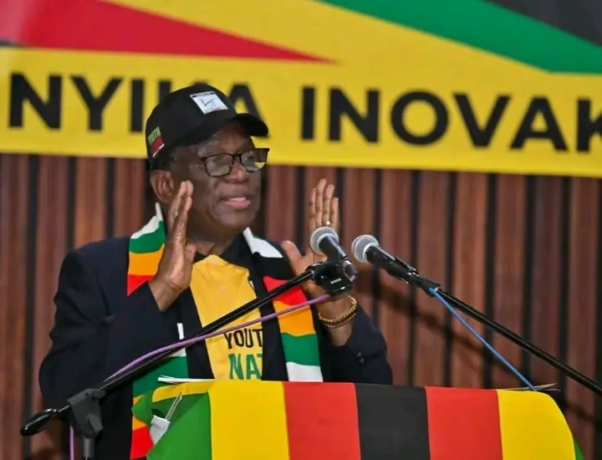
This was revealed by the Minister of Public Service, Labour and Social Welfare Professor Paul Mavima while officially opening the 9th edition of the Continental Africa Public Service Day commemorations here on Friday.
Prof Mavima said there is a need for an urgent and radical transformation of Africa’s public service with high-performance public servant who have unquestionable integrity and a broader pan- African perspective.
“In order to produce this type of a cadre, we need to revisit our education, training and development architecture. To this end, Zimbabwe, under our Public Service Commission, is revamping its human capital development architecture by creating a Public Service Academy which will enhance skills, engender a positive attitude, inspire patriotism, and inculcate a culture of high performance in the public service,” he said.

“In the area higher-learning, we have introduced the heritage-based, Education 5.0 model. This has seen institutions of higher learning spearheading research and innovation for industrialisation.”
Prof Mavima said the model is expected to move the country towards an innovation-led, and knowledge-driven economy, as envisaged under the African Union Agenda 2063.
“On the onset, I must express Zimbabwe’s recognition of the critical role and function of the Public Service in nation building and development. A role which must now be elevated beyond the individual nation state, towards African unit, development and renaissance,” he said.
The minister noted that corruption and bad governance remain significant obstacles to development in Africa costing the continent billions of dollars annually.
“These resources could otherwise be invested in vital public services and infrastructure. To combat corruption and promote good governance, we must strengthen our institutions, promote transparency, and uphold rule of law,” said Prof Mavima.
“This requires robust anti-corruption mechanisms, such as strengthening of financial regulatory frameworks, and fostering a culture of accountability at all levels of society.”
Prof Mavima said the adoption of technology can also play a crucial role in reducing corruption.
“Digital platforms for public service delivery, procurement, and financial transactions can help minimise opportunities of graft and enhance transparency,” he said.

Prof Mavima said Africa has a great opportunity for radical economic and social transformation through the effective implementation of the African Continental Free Trade Area (AfCFTA).
“The readily available key to unlock this potential is continental economic integration. Effective implementation of the African Continental Free Trade Area will consolidate the African market by creating the world’s largest free trade area spanning 54 countries, with a population of more than 1,3 billion people, a potential combined GDP of around US$3,4 trillion and the possibility of increasing intra-Africa trade to between 40-50 percent,” he said.
“This is a game-changer in creating opportunities for decent jobs and decent lives for our people as well as enhancing the competitiveness of African businesses, thereby helping to fulfil our continental Vision 2063 of the Africa We Want.”
Prof Mavima said it is worrying to note that Africa contributes only 3 percent of global trade, even though it accounts for 17 percent of the world’s population. Intra-Africa trade presently stands at only 15 percent.
“The African region today is home to a labour force that is almost 500 million. By 2030, the size of the labour force will have grown to 676 million, a staggering increase, driven by the rapidly growing number of youth labour market entrants,” he said.
“Africa is currently the world’s youngest region; and young people under 25 years old constitute 60 percent of the population. By 2030, almost one fifth of the global labour force and nearly one third of the global youth labour force will be from this region.”
Pro Mavima said as the situation stands now, some 252 million working people in Africa are poor.
“Approximately 54,5 million young people are not in education, employment or training. In North Africa the youth unemployment rate is more than 30 percent; over 40 percent for young women, which is higher than anywhere else in the world,” he said.
“Informality is pervasive involving 85 percent of all workers and 95 percent of young workers.”

Minister of Public Service, Labour and Social Welfare Professor Paul Mavima
Prof Mavima said Africa’s youthful population is brimming with talent, energy, and ambition.
“Average levels of education have steadily risen. Economic growth has been good overall, and macroeconomic conditions have been stable. While conflicts continue in parts of the continent, they have generally diminished in the past few years. The region continues to be rich in natural resources,” he said
“It is clear that the economic and social vision that we have for Africa, which is also eloquently articulated in many national development strategies, can only be achieved through a fit-for-purpose African public administration.”
Prof Mavima urged Africa’s public service to embrace the 4th Industrial Revolution.
“We have exciting tools at our disposal. These include artificial intelligence, automation, 3D printing, internet of things, and internet of everything among many others,” he said.
“These tools have changed the way we live, work, play, and access services. The African public administration cannot afford to lag behind in the deployment of technology in our service delivery if we are to meet the expectations of our citizenry and achieve greater customer satisfaction.”
Prof Mavima said the deployment of technology in public service delivery will also significantly reduce face-to-face interaction between citizens and civil servants thereby reducing chances of corruption.
“I would therefore like to encourage us all to be champions of e-government in our respective countries. And to go beyond that and to call for continent wide integration of our technological systems for easier sharing of information and transacting across the continent,” he said.
Chronicle