By Aldridge Dzvene
The Parliament of Zimbabwe is moving to strengthen the technical capacity of the legislature through a strategic academic partnership with Lupane State University, an arrangement that places higher education at the centre of efforts to improve parliamentary research, legislative scrutiny and institutional performance.
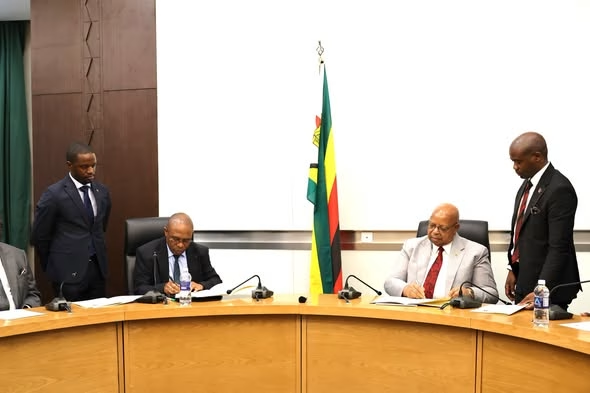
The Memorandum of Understanding, signed at the New Parliament Building in Mt Hampden in November 2026, establishes a framework for cooperation between the two institutions, with particular attention to strengthening the Zimbabwe Parliament Academy, the legislature’s emerging institutional training facility.
At the heart of the agreement is an issue with implications for the country’s entire governance architecture: the capacity of Parliament to access specialised knowledge, develop professional competencies and make informed decisions on increasingly complex national development questions.
Presenting his remarks at the signing ceremony, Speaker of Parliament Hon. Advocate Jacob Francis Nzwidamilimo Mudenda said the partnership was intended to transform academic knowledge into practical support for legislative work, with university research informing the policy choices brought before Parliament.
The Speaker disclosed that the Zimbabwe Parliament Academy currently does not possess the academic accreditation required to offer recognised certificate, diploma and undergraduate qualifications. The proposed relationship with Lupane State University therefore creates a potential pathway towards academic affiliation, subject to the necessary regulatory approvals.
This is a significant institutional consideration. While parliamentary training can equip legislators and staff with knowledge of legislative procedures, the development of recognised academic programmes requires appropriate academic standards, quality assurance and accreditation arrangements.
Through the proposed collaboration, Lupane State University is expected to assist in reviewing and refining modules already developed by the Parliament Academy, strengthen their teaching and assessment frameworks, and contribute to the development of additional programmes.
The implications extend beyond the professional development of Members of Parliament.
Parliament’s constitutional responsibilities require an institution capable of examining government policies, scrutinising public expenditure, evaluating national programmes and holding public institutions accountable. These functions increasingly intersect with technical disciplines that demand specialised knowledge.
For instance, parliamentary scrutiny of infrastructure development requires an understanding of project financing, procurement, implementation timelines and value for money. Examination of agricultural policy requires knowledge of production systems, markets, climate resilience and rural economic development.
Likewise, effective oversight of public finances requires the ability to interrogate revenue projections, expenditure priorities, debt obligations and the relationship between budget allocations and actual development outcomes.
These are areas in which the contribution of universities can extend beyond conventional academic instruction into practical institutional support.
Lupane State University brings relevant academic capabilities to this undertaking. Its disciplines include Development Studies, Geography and Geo-Information Sciences, Community Studies, Communication and Media Studies, and Commerce.
Its research interests encompass public policy, governance, monitoring and evaluation, fiscal and monetary policy, economic growth and industrialisation.
The university’s Centre for Evaluation Science also provides a potentially important resource through its focus on evaluation systems, institutional assessments, surveys and evidence-based decision-making.
These competencies could strengthen Parliament’s capacity to examine the effectiveness of public programmes and assess whether development interventions are delivering their intended results.
Vice-Chancellor Professor Pardon Kuipa identified public administration and governance, together with monitoring and evaluation, among the areas in which the university could contribute to the partnership. He also indicated that the collaboration would extend to the continuous training and professional development of parliamentary staff.
An equally important dimension concerns the relationship between Parliament and the communities it represents.
Constituencies have different economic structures, development priorities and service delivery challenges. Strengthening constituency reporting and parliamentary communication could improve the flow of information between communities and the national legislature, allowing local development experiences to inform broader policy discussions.
The agreement also follows Parliament’s earlier partnership with Bindura University of Science Education, which focused on Artificial Intelligence. The two arrangements reflect an institutional approach towards drawing on specialised university knowledge to respond to the changing demands of parliamentary work.
For Lupane State University, the collaboration offers an opportunity to extend its research and academic capabilities into the operations of a national constitutional institution. For Parliament, it presents an opportunity to build a more structured system of professional development and research-informed legislative practice.
However, the proposed academic affiliation will require the appropriate regulatory processes, and the partnership’s effectiveness will depend on the quality of its implementation, the relevance of its training programmes and the extent to which research findings are incorporated into parliamentary work.
Ultimately, the value of the agreement will be measured by more than the establishment of training programmes or the number of officials who undergo professional development.
Its deeper contribution would be a legislature better equipped to examine national development policies, interrogate the use of public resources and make informed decisions on matters affecting the country’s economic and social transformation.
The partnership therefore places an important responsibility on the higher education sector to contribute not only to the production of skilled graduates, but also to strengthening the national institutions through which development policies are examined, refined and monitored.