Zimbabwe has taken its first formal steps toward the introduction of Video Assistant Referee (VAR) technology, with a two-day FIFA-led kick-off workshop held in Harare starting 21 September, supported by funding from Sakunda Holdings.
The programme brought together the Zimbabwe Football Association (ZIFA), the Premier Soccer League, clubs, and representatives from government and local authorities. It was led by FIFA instructor Felix Tangawarima, who is heading the Zimbabwe project, together with other FIFA experts.
ZIFA President Nqobile Magwizi said the initiative forms part of the association’s wider modernisation drive, but cautioned that deployment would be gradual and dependent on meeting all readiness requirements.
He explained that commencing the process does not mean VAR will appear in the next league round, stressing the need for 9structured and phased preparation.

Sakunda Holdings Dr Chief Executive Officer Kudakwashe Tagwire
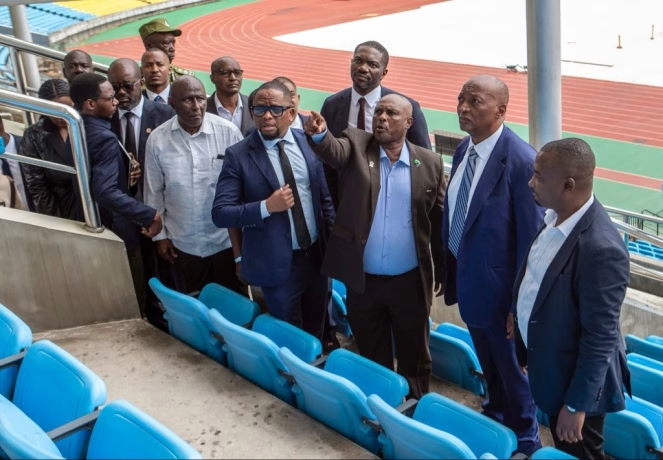
Sakunda Holdings has pledged financial backing for the initial phase, covering three key venues – Rufaro Stadium, Barbourfields Stadium and the National Sports Stadium – with provision to extend to other grounds recommended by ZIFA. Chief Operating Officer Mberikwazvo Chitambo, speaking on behalf of Chief Executive Officer Dr Kudakwashe Tagwirei, said the company fully supports ZIFA’s ambitions on the project.

FIFA Instructor, Tangawarima emphasised the need to build local capacity, particularly for technical and operational functions. He noted that Zimbabwe already has seven officials with VAR training obtained through CAF and COSAFA programmes, providing a foundation to build on.
The move represents a significant opportunity for the domestic game. Enhanced support for match officials can help protect the work invested by players and coaches in preparation for competition, while contributing to greater supporter confidence in the handling of decisive moments.
Achieving those benefits will require a methodical process. Under FIFA’s Implementation Assistance and Approval Programme (IAAP), any new competition organiser must satisfy a set of requirements, including testing and formal approval of the technology, before VAR can be used competitively.
A central element is stadium readiness. FIFA requires technology validation at each venue where VAR has not previously been deployed, making ground preparation and decisions on equipment and service providers a critical part of the timeline.
In practical terms, progress will be measured by preparedness rather than pace. Successful implementation depends on skilled operators, reliable match-day systems and a clear understanding of responsibilities when the on-field referee calls for assistance.
The scope of VAR is also defined. Under the International Football Association Board (IFAB) protocol, intervention is limited to specific situations involving a potential clear and obvious error or a serious missed incident. Final authority remains with the referee on the pitch.
Officials will continue to make their initial decisions in real time. Where a review is needed, the referee may act on information from the video official or check footage at the pitchside review area, making VAR an additional source of evidence rather than a replacement for on-field judgement.
The protocol also sets behavioural expectations, requiring players and technical staff to allow reviews to proceed without attempting to influence the official. Understanding these procedures will be vital as implementation advances.
Public education is equally important. Supporters need straightforward information on what can be reviewed, why certain incidents are examined in greater detail and why others are not. Accessible communication will help fans follow the process and judge it against its intended purpose.
For referees, the project offers broader professional development. Investment in specialist skills can encourage a culture of preparation, careful decision-making and continuous learning, with officials provided both the tools to manage demanding duties and clear standards for assessment.
More widely, the initiative underscores that sustainable improvement requires shared responsibility. Administrators, commercial partners, stadium operators and football stakeholders each have a part to play, with their contributions needing to converge around the needs of the match and those who play, officiate and watch it.
These latest developments align directly with ZIFA’s long-term strategic blueprint, Dream 2030, launched in July 2026. The plan outlines a comprehensive reform agenda to modernise Zimbabwean football, strengthen governance, raise competition standards and bring the domestic game in line with international best practice, with officiating, technology and infrastructure identified as key pillars.
The start of the IAAP process in Harare, backed by Sakunda, is therefore being framed as a practical delivery of Dream 2030 objectives – moving from policy to measurable improvements on the pitch. Officials have indicated that upcoming milestones, including venue assessments and advanced personnel training, will be executed in accordance with the Dream 2030 roadmap.
The immediate task is to convert that shared commitment into consistent practice, maintaining attention to detail and keeping the interests of Zimbabwean football at the centre of every decision as foundations for a more professional and credible game are laid.