BY ALDRIDGE DZVENE
HARARE – President and First Secretary of ZANU PF, His Excellency Cde Dr Emmerson Dambudzo Mnangagwa, has raised the political and economic expectations placed on young women, challenging them to convert access to Government empowerment programmes into productive enterprises capable of contributing to Zimbabwe’s industrialisation drive.
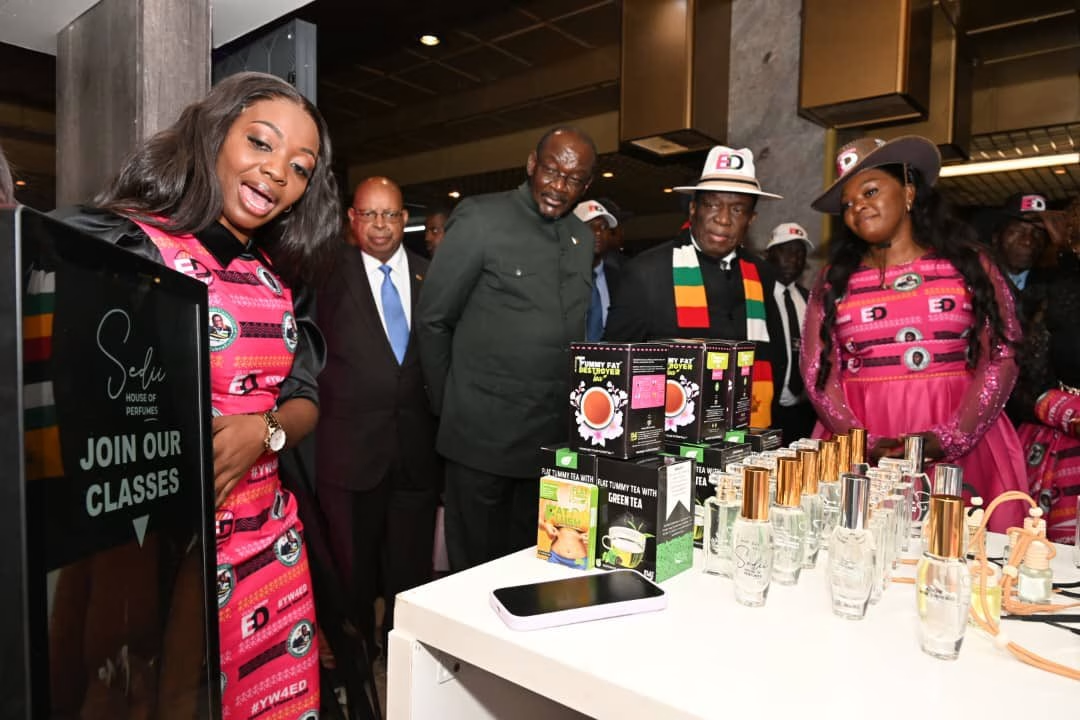
Opening the Second Edition of the Young Women for Economic Development Convention in Harare, President Mnangagwa used the organisation’s five-year milestone to redefine what should constitute success in the next phase of its growth.
The emphasis was not on the number of programmes delivered, but on what those programmes produce.
His call for transparency and a results-oriented approach to empowerment resources effectively places the organisation and the institutions supporting it under a new form of scrutiny. Funds, equipment and training can demonstrate activity, but they do not by themselves demonstrate economic transformation.
The more consequential measure is what follows.
An enterprise that expands production, employs workers, enters a value chain or reaches a regional market represents a substantially different outcome from a project that remains dependent on repeated interventions.
This is particularly important as Government attempts to broaden participation in the productive economy.
President Mnangagwa encouraged women-led businesses to move beyond the traditional SME space into manufacturing, agro-processing and value addition. Such a transition would allow entrepreneurs to capture more value from agricultural and other local resources while creating stronger links between small businesses and larger industrial systems.
But moving into those sectors exposes the limitations of empowerment programmes that operate in isolation.
Capital without markets is insufficient. Training without equipment has limited value. Production without reliable logistics, energy and working capital cannot easily scale.
The effectiveness of the policy will therefore depend not only on the resources provided to young women, but on the economic infrastructure surrounding them.
This is where the organisation’s grassroots footprint becomes significant.
Young Women for Economic Development has established structures across provinces and districts, while its members have increasingly entered local authorities, Parliament and Government. President Mnangagwa linked this political growth to the organisation’s wider role in communicating national programmes and strengthening participation at community level.
That creates an opportunity to turn grassroots structures into a feedback mechanism for development.
The ward or district should not merely receive information about an empowerment programme. It should also be able to reveal whether the programme is working, who is being reached, what barriers beneficiaries encounter and why some enterprises grow while others disappear.
Such feedback is essential if policy is to become adaptive rather than administrative.
The President’s emphasis on digital skills adds another layer to this challenge. As technology changes the structure of work and business, young women will need capabilities that allow them to create and compete rather than simply consume digital services.
But here too, training figures will tell only part of the story.
The meaningful question is how many trained young people subsequently establish businesses, secure employment, develop products or access new markets.
The same principle applies to agriculture.
The President called for increased productivity, agro-processing, value addition and marketing, signalling an expectation that women should occupy more profitable sections of agricultural value chains rather than remain concentrated at the production end.
That shift could have wider consequences for household incomes, rural enterprise and domestic manufacturing if supported by functioning markets and productive infrastructure.
The political significance of the Convention consequently extends beyond the empowerment of one constituency.
It reflects an attempt to connect organised political participation with the practical implementation of the national development agenda.
Young women are being asked to play several roles at once, as citizens, entrepreneurs, community leaders and participants in the structures through which national programmes are communicated and implemented.
That convergence makes accountability more important, not less.
If public resources are being channelled towards economic empowerment, the country should be able to determine their outcomes.
How many businesses remain operational?
How many have expanded?
How many jobs have been created?
How many have entered manufacturing?
How many have accessed formal markets?
How many have progressed from beneficiaries to employers and investors?
These are the indicators that will ultimately distinguish an empowerment programme that distributes opportunity from one that changes the structure of economic participation.
President Mnangagwa has therefore set a demanding benchmark for the next phase of Young Women for Economic Development.
The task is no longer simply to build a larger organisation or reach more beneficiaries. It is to demonstrate that political organisation, public investment and entrepreneurial support can produce durable economic capacity.
That makes the period ahead one that should be watched through evidence rather than ceremony.
The real story will be found in the businesses that survive after the funding is disbursed, the products that reach markets after the training ends and the jobs that remain long after the convention closes.
If the empowerment architecture succeeds, its strongest evidence will not be found on a convention stage.
It will be found in factories, farms, workshops, digital enterprises, supply chains and household incomes across the country.