By Aldridge Dzvene
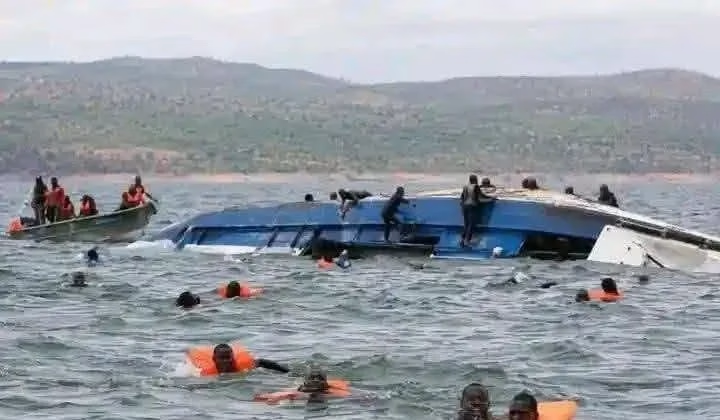
HARARE – Government has formally opened investigations into the capsizing of the Rural Infrastructure Development Agency (RIDA) Mbuya Nehanda ferry on Lake Kariba, bringing the disaster into a new phase where the central question is no longer simply how the vessel sank, but whether a chain of preventable decisions and institutional weaknesses contributed to the loss of more than 90 lives.
The ferry capsized on 11 August 2026 after reportedly being struck by strong waves, with preliminary Government findings indicating that about 180 passengers and goods were aboard, exceeding the vessel’s carrying capacity.
Minister of Women Affairs, Community, Small and Medium Enterprises Development, Senator Monica Mutsvangwa, said formal investigations will examine the structural remains of the vessel as well as operational and compliance issues.
That distinction is critical.
A vessel encountering severe weather is not, by itself, sufficient to explain a disaster of this magnitude. A deeper investigation must establish the conditions that existed before the ferry entered the water, the decisions made during loading, the information available to the crew, the enforcement of passenger limits and the adequacy of systems designed to prevent an unsafe voyage.
There is now an additional question emerging from accounts given by survivors.
Some passengers reportedly raised concerns about the deteriorating weather and conditions surrounding the vessel before it proceeded with the journey. One survivor told the press that passengers confronted the captain after strong winds and the loss of equipment into the water, but their concerns were reportedly dismissed, with the captain indicating that his experience on Lake Kariba gave him confidence that conditions would improve.
If corroborated by the formal investigation, such accounts could become significant because they would shift part of the inquiry from the physical cause of the capsizing to the decision-making environment aboard the vessel.
The issue is not whether the captain should be blamed for the disaster before the evidence is assembled. He died in the accident and cannot give his account of events. The issue is whether established safety procedures allowed individual judgment to override warnings from passengers, weather information or observable conditions on the lake.
That distinction matters.
Professional maritime safety depends on systems that do not rely exclusively on the confidence or personal judgment of one individual. When conditions deteriorate, there should be clearly defined thresholds for delaying departure, reducing passenger loads, seeking technical guidance or terminating a voyage.
The reported passenger concerns therefore deserve to be tested against evidence from the investigation, including communications, weather records, passenger testimony, crew procedures and the vessel’s operational records.
Government has already indicated that the Meteorological Services Department issued an early warning.
This creates another important line of inquiry: how effectively was that warning converted into operational action?
An early-warning system only protects citizens when the information reaches the people responsible for making decisions and when those decisions are governed by enforceable safety protocols.
The reported overloading of the ferry makes the question even more serious.
Carrying capacity is not merely an administrative figure. It is connected to vessel stability, emergency equipment, evacuation capacity and the ability of a vessel to withstand changing weather and water conditions.
If the preliminary finding of overcapacity is confirmed, investigators will have to establish who authorised the additional passengers and goods, whether passenger numbers were properly recorded, whether the vessel was cleared to depart and whether existing enforcement mechanisms were functioning.
This is where the Kariba tragedy develops into a broader national governance issue.
Public infrastructure is ultimately measured not only by whether it exists, but by whether the systems surrounding it protect the people who depend on it.
The Mbuya Nehanda disaster therefore raises questions about institutional accountability without prejudging the outcome of the investigation.
Were safety regulations properly enforced?
Were weather warnings operationally integrated into voyage decisions?
Was the vessel’s carrying capacity effectively monitored?
Were passenger concerns given appropriate consideration?
Were inspection and compliance mechanisms functioning?
And, critically, did the system provide sufficient safeguards against a single poor decision becoming a mass-casualty event?
These questions should not be confused with conclusions. They are the questions that a credible investigation must answer.
President Dr Emmerson Dambudzo Mnangagwa has declared the tragedy a State of Disaster under Section 27(1) of the Civil Protection Act and directed authorities to provide affected families with funeral services, medical assistance and psychosocial support.
The Department of Civil Protection, the Zimbabwe Republic Police Sub Aqua Unit, the Zimbabwe National Army Boat Squadron, local authorities and other stakeholders continue search and recovery operations, supported by a privately owned helicopter from the Matusadona Conservation Trust.
But the humanitarian response and the accountability process must run on parallel tracks.
Families need their relatives recovered, identified and accorded dignified burials. At the same time, the country needs a factual reconstruction of the events that preceded the disaster.
The investigation should therefore move beyond the question of whether strong waves caused the ferry to capsize.
The stronger national question is whether the waves were the only uncontrollable factor in a chain of events that culminated in the tragedy.
If investigators establish that adverse weather interacted with overloading, inadequate risk assessment, ignored warnings or weaknesses in regulatory enforcement, then the policy response cannot simply be to improve the vessel or issue another safety circular.
The entire safety architecture of Zimbabwe’s inland water transport would require examination.
That includes vessel certification, passenger manifests, enforcement of capacity limits, weather-warning protocols, crew training, emergency equipment, inspection regimes and response capacity in remote areas.
Lake Kariba is not merely a tourism destination. It is an economic and social lifeline for communities that depend on it for transport, fishing and commerce. Safety failures on the lake therefore carry consequences far beyond one vessel and one journey.
The Mbuya Nehanda disaster has exposed the difference between having regulations on paper and having institutions capable of enforcing them in real time.
That is why the investigation matters.
For the families still waiting for answers, a report that merely records that the ferry encountered strong waves will not be enough.
The country needs to know what was known, what was warned, what was decided, what was ignored and where the safeguards failed.
Only then can the tragedy become more than a national mourning point. It can become the basis for rebuilding a stronger maritime safety system in which warnings are acted upon, capacity limits are enforced and the protection of human life takes precedence over the pressure to complete a journey.