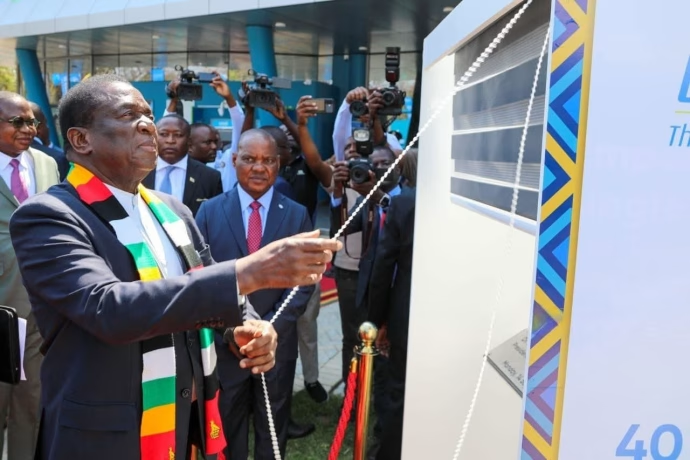
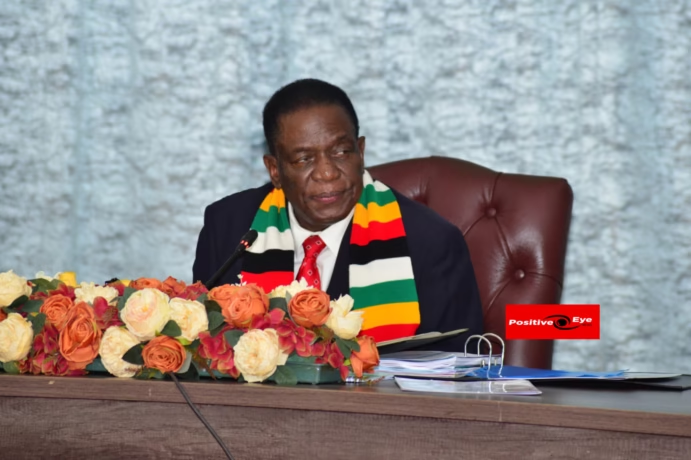
Zimbabwe used this year’s Africa Day commemorations to project a broader vision for Africa’s place in global affairs, calling for a world order founded on Ubuntu, sovereign equality, cooperation and African-led solutions to contemporary development challenges.
Speaking during the 63rd Africa Day celebrations in Harare, the Minister of Foreign Affairs and International Trade, Professor Amon Murwira, articulated a diplomatic philosophy that places African values at the centre of international relations, while positioning Zimbabwe as an advocate for a more inclusive and equitable global governance system.
The celebrations came at a particularly significant moment for Zimbabwe following its election as a non-permanent member of the United Nations Security Council after securing an overwhelming 182 votes out of 190. The outcome has been widely viewed as an endorsement of Zimbabwe’s engagement and re-engagement policy as well as its commitment to multilateral cooperation and international peace.
Against this backdrop, Professor Murwira’s address transcended the traditional commemorative nature of Africa Day. Instead, it presented a strategic reflection on Africa’s role within an evolving international order increasingly characterised by geopolitical competition, economic uncertainty and growing calls for reform of global institutions.
Central to Zimbabwe’s message was the philosophy of Ubuntu, a concept deeply rooted in African civilisation that emphasises interconnectedness, mutual respect, collective responsibility and shared prosperity. By elevating Ubuntu as a framework for international engagement, Zimbabwe effectively argued for a departure from adversarial approaches that have historically dominated global relations.
The call for non-adversarial relations reflects a growing school of thought within Africa that views cooperation rather than confrontation as the most sustainable pathway towards peace, development and global stability. It is a perspective that aligns with Zimbabwe’s longstanding position advocating dialogue, diplomacy and multilateral engagement as preferred mechanisms for resolving international disputes.
Professor Murwira’s remarks also underscored the growing importance of sovereignty in contemporary international relations. For many African countries, sovereignty extends beyond political independence to encompass economic self-determination, resource control and the ability to pursue development pathways that reflect national priorities and local realities.
This perspective resonates strongly with the aspirations contained in the African Union’s Agenda 2063, which envisions an integrated, prosperous and peaceful continent driven by its own citizens and capable of influencing global affairs.
Zimbabwe’s election to the United Nations Security Council was therefore presented not merely as a national achievement but as a victory for Africa’s collective voice. The country’s presence on the Security Council provides an opportunity to contribute to discussions on international peace and security while advancing issues of importance to the African continent.
In many respects, the election reinforces Africa’s growing demand for greater representation and influence within global governance institutions. As debates continue regarding the reform of international structures established in a different historical era, African nations are increasingly advocating for a system that reflects contemporary geopolitical realities and demographic trends.
Another key dimension of the Minister’s address was the emphasis on water security and sanitation, which form the African Union’s theme for 2026. While often viewed as developmental issues, access to clean water is increasingly recognised as a strategic concern linked to public health, agricultural productivity, industrial growth, environmental sustainability and national security.
Professor Murwira’s assertion that water security is essential to sovereignty highlights the growing intersection between natural resources and development policy. Across Africa, climate change, population growth and urbanisation are intensifying pressure on water resources, making effective management increasingly critical for long-term economic resilience.
The Minister’s call for self-reliance and development models rooted in African realities further reflected a broader continental conversation about reducing dependency, strengthening local capacities and leveraging indigenous knowledge systems in pursuit of sustainable development.
This vision does not reject international cooperation. Rather, it advocates partnerships founded on mutual respect, equality and shared benefit, principles that Zimbabwe has consistently promoted within its foreign policy engagements.
Ultimately, the Africa Day commemorations provided Zimbabwe with an opportunity to articulate a vision that connects sovereignty, development, peace and African identity within a single framework. The message was clear: Africa’s future prosperity will be shaped not only by economic growth and technological advancement but also by the continent’s ability to remain united, protect its sovereignty and advance development approaches grounded in its own values and aspirations.
As Africa continues its journey towards the aspirations of Agenda 2063, Zimbabwe’s call for an Ubuntu-driven global order reflects a belief that the continent possesses both the philosophical foundations and strategic capacity to contribute meaningfully to the shaping of a more balanced, cooperative and inclusive international system.