By Aldridge Dzvene
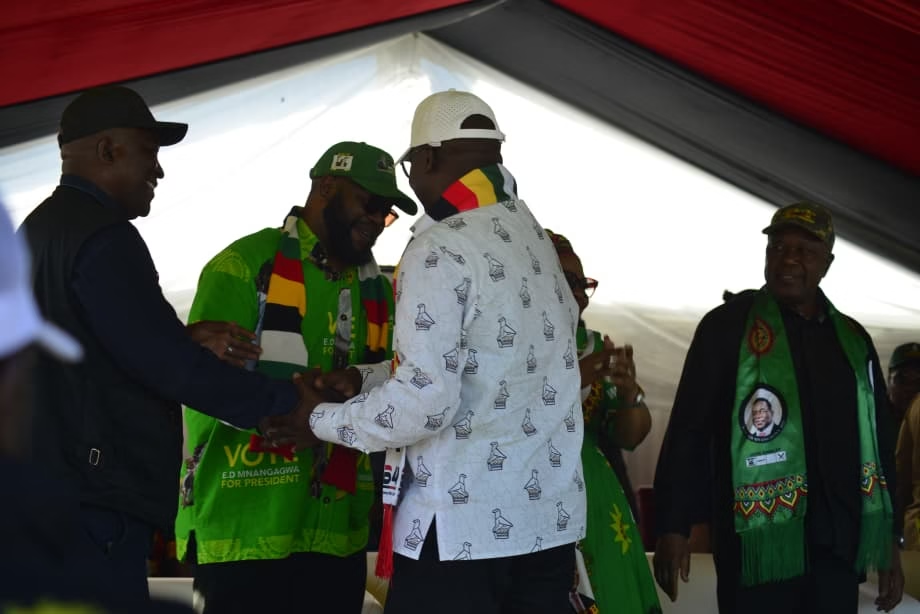
Chipinge, Zimbabwe — The usually quiet grounds of Chipinge Junior School were transformed into a politically charged arena on 11 April, as ZANU PF’s top leadership converged to affirm the elevation of Dr Paul Tungwarara into the party’s Central Committee, in what analysts view as a strategic consolidation of grassroots-driven leadership aligned to national development priorities.
The event, attended by senior party figures and liberation stalwarts, was not merely celebratory, it carried the weight of political messaging, ideological continuity and succession signaling within the ruling party. At the centre of this moment stood Oppah Muchinguri-Kashiri, ZANU PF National Chairperson and Minister of Defence, whose presence as Guest of Honour underscored the significance of the appointment within the party’s hierarchy.
Addressing the gathering, Hon Muchinguri-Kashiri framed DrTungwarara’s rise as a product of action-oriented leadership rooted in loyalty, discipline and tangible delivery at grassroots level. She described him as a key instrument in advancing the vision of H.E Dr Emmerson Mnangagwa, particularly in the area of empowerment and community transformation.
“He is a man who delivers to the people. His work speaks directly to the President’s vision of uplifting communities,” she said, drawing a direct link between Dr Tungwarara’s development initiatives and the broader trajectory of Vision 2030.
The political undertone of the event was further amplified by the presence of influential figures such as Christopher Mutsvangwa, Secretary for Information and Publicity,Hon Monica Mutsvangwa, and Cde Douglas Mahiya, all of whom represent the ideological backbone of the party, rooted in liberation war credentials and institutional memory.
Their collective endorsement of Dr Tungwarara signals more than internal party recognition, it reflects a deliberate alignment between the liberation generation and emerging leadership figures tasked with driving economic transformation. Within ZANU PF’s political architecture, such moments are rarely incidental, they serve to reinforce continuity while projecting a forward-looking governance model anchored on development.
From a political standpoint, Dr Tungwarara’s profile as an empowerment-driven figure has become central to his ascendancy. His involvement in projects such as borehole drilling, housing for war veterans, and village business units positions him within the ruling party’s broader narrative of decentralised development and inclusive growth under the National Development Strategy framework.
In his acceptance remarks, Dr Tungwarara struck a tone of loyalty and commitment, pledging to work closely with President Mnangagwa in advancing national development goals. His message resonated strongly with the crowd, reinforcing the ruling party’s emphasis on unity, discipline and collective responsibility in achieving economic transformation.
“I will work with our President to shape the future of our country,” he said, aligning his political trajectory with the national vision.
The event also reflected the operational strength of provincial structures, with Minister of State for Provincial Affairs and Devolution Misheck Mugadza and Manicaland Provincial Chairman Tawanda Mukodza emphasising unity, mobilisation and grassroots participation as key drivers of political and developmental progress.
Beyond the speeches and symbolism, the gathering revealed a deeper strategic narrative within ZANU PF, the integration of liberation legacy with a new cadre of leaders whose legitimacy is increasingly tied to delivery rather than rhetoric.
The presence of liberation war veterans and senior party officials alongside Dr Tungwarara effectively positioned his appointment as part of a broader continuum, where the ideals of the liberation struggle are being recalibrated toward economic empowerment and social development.
In this context, Chipinge became more than a venue, it became a stage where the ruling party projected its internal coherence, its succession logic, and its commitment to grassroots-centred governance.
As ZANU PF continues to reposition itself within the demands of a modern economy, the elevation of figures like Dr Paul Tungwarara signals a calculated shift, one that blends historical legitimacy with developmental pragmatism, in pursuit of a unified national agenda.
The message from Chipinge was clear and deliberate, leadership within the party is being defined not only by ideological alignment, but by the capacity to translate vision into tangible outcomes for the people.