Story by Aldridge Dzvene
Harare – The regional steel sector is entering a decisive phase as South Africa moves to fortify its domestic industry while Zimbabwe’s rapidly expanding production capacity begins to assert itself within the Southern African market, placing the dynamics of trade, industrial policy and regional integration under intense scrutiny.
Recent developments by the South African authorities, through the International Trade Administration Commission, have seen the imposition of steep anti-dumping tariffs on structural steel imports from Asia, targeting countries such as China and Thailand. While framed as a defensive measure against unfair competition, the move signals a broader recalibration of industrial protection, one that inevitably reshapes the competitive landscape within the region.
At the centre of this unfolding contest is ArcelorMittal South Africa, long regarded as a cornerstone of South Africa’s industrial base. Confronted with declining demand, ageing infrastructure and rising operational pressures, the company and its counterparts are increasingly reliant on state-backed safeguards to maintain viability. This has placed Pretoria in a delicate position, balancing the need to preserve domestic capacity against the realities of a changing regional market.
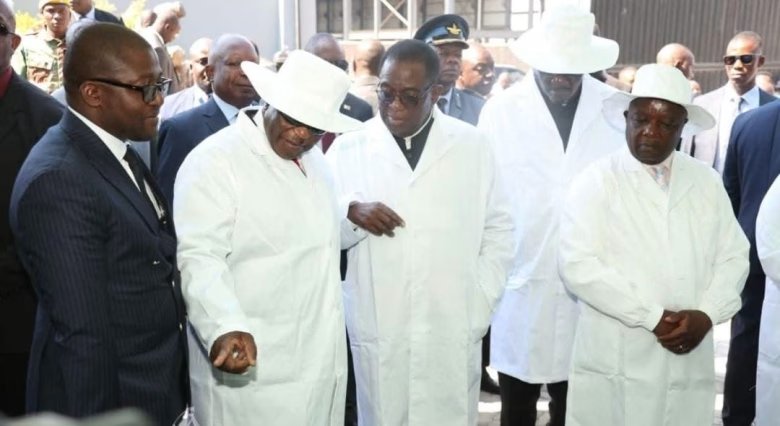
Parallel to this, Zimbabwe’s industrial resurgence is becoming more pronounced, anchored by the emergence of Dinson Iron and Steel Company in Manhize. Once viewed as a long-term ambition, the project has transitioned into an active production hub, with pig iron and rebar already entering the market. Backed by significant capital injection from Tsingshan Holding Group, the plant’s vertically integrated model offers a structural cost advantage, leveraging locally available iron ore as opposed to scrap-based production systems.
This shift introduces a new competitive variable. Lower production costs, combined with scale ambitions that stretch toward millions of tonnes annually, position Zimbabwe not merely as a domestic supplier but as an emerging regional exporter. Even at its current capacity, surplus output is being directed toward neighbouring markets, including South Africa, intensifying pressure on established producers.
What is unfolding is not a simple trade dispute, but a strategic contest between protection and efficiency. South African upstream producers are expected to push for broader tariff extensions to shield their operations from both global and regional competition. However, downstream industries, particularly construction and manufacturing, face a different reality. Their competitiveness is closely tied to access to affordable, high-quality inputs, making lower-cost imports an economic necessity rather than a threat.
This divergence of interests places policymakers in a complex position. Protective tariffs may preserve industrial capacity in the short term, but they risk raising input costs across the economy, potentially slowing infrastructure development and industrial expansion. Conversely, opening the market to competitive imports could accelerate growth in downstream sectors, while exposing domestic producers to heightened pressure.
Beyond national considerations, the situation carries broader regional implications. Frameworks such as the African Continental Free Trade Area and regional integration commitments under SADC emphasise cooperation, reduced trade barriers and shared economic growth. Any move perceived as restrictive towards neighbouring producers risks undermining these principles and introducing friction into regional trade relations.
Zimbabwe’s position, meanwhile, reflects a deliberate industrial policy under the National Development Strategy 2, where value addition, beneficiation and domestic production are central pillars. The rise of local steel manufacturing is not only about market share, but about redefining the country’s economic structure, shifting from raw material exports to industrial output.
The intersection of these trajectories creates a moment of strategic importance for the region. South Africa must navigate the preservation of its industrial base without isolating itself from regional supply chains, while Zimbabwe must consolidate its production gains and establish reliability, quality and consistency in supply.
As the anticipated broader Steel Tariff Review findings approach, the decisions taken will have far-reaching consequences, shaping not only the future of the steel industry but also the trajectory of regional industrialisation. The balance between protection, competitiveness and cooperation will determine whether the current tensions evolve into conflict or converge into an opportunity for integrated growth.
In this unfolding scenario, the steel sector becomes more than an industry, it is a reflection of how nations position themselves within a transforming economic landscape, where production capacity, policy direction and regional relations are increasingly intertwined.