Zimbabwe’s infrastructure modernisation drive under National Development Strategy 2 (NDS2) continues to gather pace, with significant progress recorded on the rehabilitation of the Bulawayo–Hwange–Victoria Falls road, a strategic corridor critical to tourism, trade, and regional connectivity.
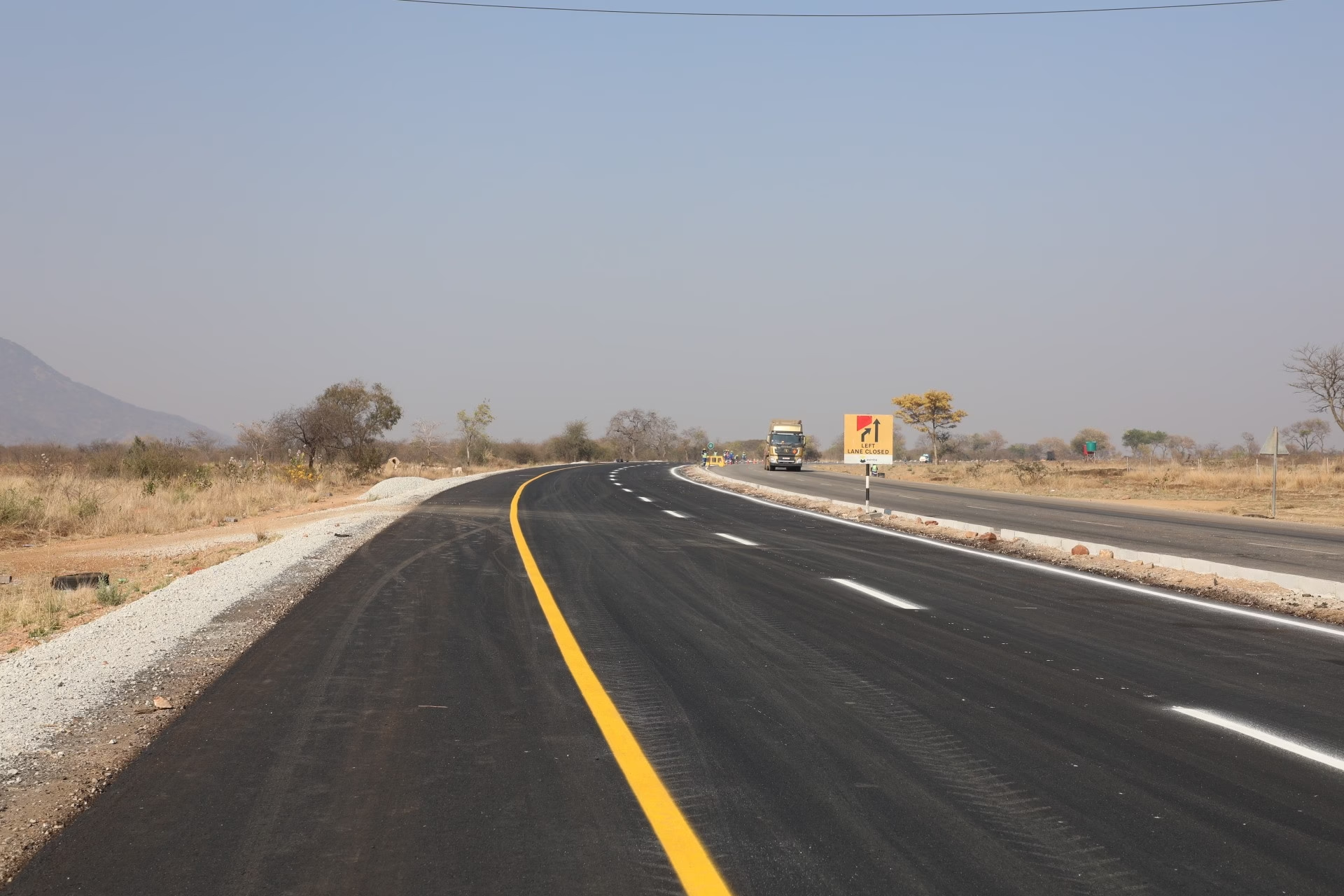
As of March 2026, government assessments indicate that the large scale project, spanning approximately 440 kilometres, is now firmly in the execution phase, with contractors working around the clock to accelerate delivery. About 47.5 kilometres have already been fully surfaced and opened to traffic, marking a tangible shift from years of deterioration that had affected both tourism flows and heavy haulage operations.
The project goes beyond routine maintenance, representing a full structural upgrade designed to meet modern transport demands. The widening of the ರಸ್ತೆ from 7 metres to 9 metres is expected to significantly improve safety and traffic flow, particularly for long haul trucks and tourist vehicles travelling between Bulawayo and Victoria Falls, one of Africa’s premier tourism destinations.
Implementation has been decentralised into eight construction lots, a strategy aimed at expediting progress through contractor specialisation and parallel execution. Key local firms including Bitumen World, Asphalt Products, Syvern Investments, and Fossil Contracting are leading various sections of the project, reflecting the Government’s “Nyika inovakwa nevene vayo” philosophy of leveraging domestic capacity in national development.
Progress across these lots is becoming increasingly visible. Bitumen World has completed over 20 kilometres on the Hwange section, while Asphalt Products is focusing on the widening of the Gwayi–Hwange stretch. Syvern Investments has already opened a 5 kilometre segment and is targeting full completion by August 2026, while Fossil Contracting continues to advance work on its extensive allocation, with several kilometres now trafficable.
From an engineering perspective, the adoption of 150 millimetre cement stabilised layers combined with double seal surfacing marks a shift toward durability and climate resilience. This approach is expected to withstand heavy rains and prolonged use, addressing historical challenges where sections of the road would deteriorate rapidly after each rainy season.
Economically, the rehabilitation of this corridor is poised to unlock multiple value chains. For the tourism sector, improved road conditions will reduce travel time and enhance accessibility to Victoria Falls, strengthening Zimbabwe’s competitiveness as a regional destination. For industry and logistics, the route facilitates the efficient movement of goods, linking mining, agricultural, and commercial hubs.
Analytically, the project reflects the broader infrastructure led growth model underpinning NDS2, where investment in transport networks is leveraged to stimulate economic activity, improve service delivery, and integrate markets. It also demonstrates a shift toward execution driven governance, where timelines, contractor performance, and measurable outputs are becoming central to public sector delivery.
While most contractors are targeting completion of their respective sections by late 2026, with some priority stretches expected by mid year, the progress achieved so far signals a decisive turnaround. For many stakeholders, from truck drivers to tourism operators, the transformation of this once challenging route is already beginning to reshape economic and social mobility.
In the context of Vision 2030, the Bulawayo–Hwange–Victoria Falls road stands as more than just an infrastructure project, it is a strategic artery of growth, reinforcing Zimbabwe’s ambition to become a connected, competitive, and resilient economy.