

Storty By Aldridge Dzvene
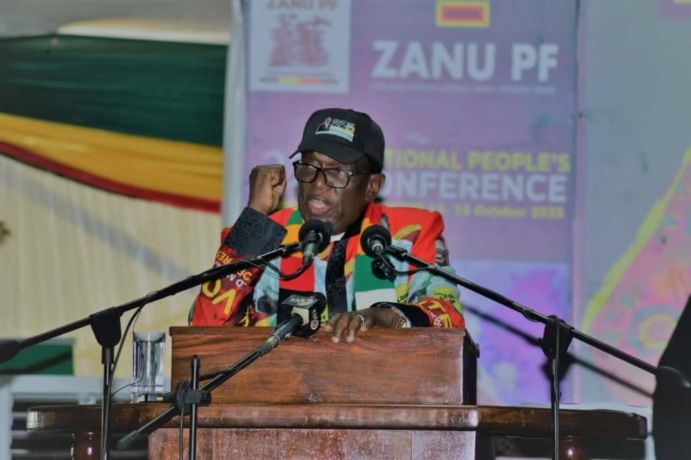
The burial of national hero Samuel Mpabanga at National Heroes Acre became more than a ceremonial farewell, it evolved into a strategic policy signal, where President Emmerson Dambudzo Mnangagwa outlined a governance and economic doctrine that places business transformation, technological innovation, and sovereign decision making at the centre of Zimbabwe’s next development phase.

Rainbow Hotels — Experience Luxury Across Zimbabwe
Rainbow Hotels continues to redefine hospitality standards in Zimbabwe, offering world-class accommodation, fine dining, and modern conference facilities in Harare, Bulawayo, and Victoria Falls.
Whether for business or leisure, Rainbow Hotels delivers unmatched comfort, exceptional service, and a truly premium guest experience tailored to modern travellers.
Book NowRather than delivering a purely memorial tribute, the President used the platform to connect liberation discipline with modern productivity, drawing a straight line from the sacrifice of freedom fighters to today’s expectations of industrial output, skills excellence, and institutional performance. The message was clear, patriotism in the Second Republic must express itself through production, systems efficiency, and innovation capacity.
The strongest thread running through the address was economic sovereignty. The President framed Zimbabwe’s policy direction as non negotiable and self determined, arguing that national development models must not be outsourced to external opinion or digital era pressure blocs. In practical terms, that stance supports tighter control over reform sequencing, regulatory design, and industrial strategy, especially as Zimbabwe pushes modernisation programmes across transport, energy, agriculture, and manufacturing value chains.
Business and infrastructure delivery were presented as active proof points, not future promises. Ongoing provincial projects, vocational training expansion, irrigation upgrades, and decentralised growth investments were positioned as structural levers to rebalance opportunity across regions. This decentralised economics approach suggests a shift from capital city centric growth toward production nodes distributed across provinces.
Education was recast not as social policy, but as economic hardware. By elevating innovation, science, and digitisation, the President effectively defined schools and universities as industrial inputs. Under this logic, Heritage Based Education 5.0 is not symbolic, it is meant to be commercially consequential, feeding startups, factories, research labs, and technology platforms. Youth were challenged to become technology heroes, industry builders, and knowledge producers, not passive job seekers.
Political governance also received a performance test framing. Discipline, humility, and loyalty, traits attributed to the late General Mpabanga, were elevated as operational requirements for today’s leadership class. The speech subtly warned against entitlement culture and bureaucratic complacency, linking ethical conduct directly to state capacity and investor confidence.
Foreign relations were woven into the economic narrative through the familiar line of friend to all, enemy to none, but with sharper emphasis on national interest first. That positioning supports wider engagement and partnership building, while protecting domestic policy space, a balancing act critical for trade, infrastructure finance, and technology cooperation.
In effect, the ceremony produced a layered doctrine, liberation values translated into productivity ethics, sovereignty translated into policy control, and patriotism translated into innovation and enterprise. The send off of a liberation commander thus doubled as a call up order for a new economic generation, measured not by slogans, but by output, invention, and delivery.