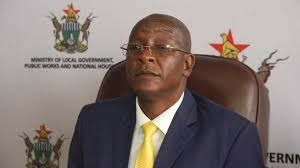


President Emmerson Dambudzo Mnangagwa has officially opened the first Cabinet meeting of 2026 with a strong call for coordinated, people centered and transformative economic action, setting the tone for Government priorities across the year and reinforcing the administration’s development driven governance approach.
Addressing Cabinet, President Mnangagwa underscored that Zimbabwe’s economic sectors are interconnected and must be managed through an integrated policy lens that links agriculture, mining, infrastructure, energy, tourism and manufacturing into a unified growth framework. He said silo based planning weakens delivery, while coordinated execution strengthens national outcomes and accelerates prosperity.

Rainbow Hotels — Experience Luxury Across Zimbabwe
Rainbow Hotels continues to redefine hospitality standards in Zimbabwe, offering world-class accommodation, fine dining, and modern conference facilities in Harare, Bulawayo, and Victoria Falls.
Whether for business or leisure, Rainbow Hotels delivers unmatched comfort, exceptional service, and a truly premium guest experience tailored to modern travellers.
Book NowThe President directed Ministers to align their programmes with a single national vision, warning against institutional rivalry and fragmented implementation. He stressed that Cabinet must function as a cohesive delivery engine, focused on results rather than internal competitiveness, with measurable impact on citizens’ livelihoods.
A key policy signal from the session was the directive to finalize the review of licences, permits, levies and fees across sectors. President Mnangagwa said rationalising regulatory and cost structures is necessary to improve the ease of doing business, attract investment and unlock private sector expansion. The reform thrust positions regulatory efficiency as a central pillar of Zimbabwe’s competitiveness strategy.
On governance and accountability, the President called for stronger transparency systems and reaffirmed the role of the media as a public accountability partner. He encouraged responsible reporting that supports openness and institutional responsiveness, while strengthening public trust in Government processes.
Agriculture featured prominently in the President’s outlook, with optimism anchored on favourable rainfall patterns this season. However, he urged proactive disaster preparedness and climate risk mitigation measures, indicating that weather variability remains a structural risk to production and food security. His remarks reflect a dual approach of opportunity maximisation and risk management within the agricultural sector.
At a regional level, President Mnangagwa reaffirmed Zimbabwe’s commitment to SADC solidarity, especially in supporting neighbouring countries affected by climate related disasters. This positions Zimbabwe’s development agenda within a broader regional cooperation and resilience framework.
He also challenged Ministers to demonstrate servant leadership, active oversight and consistent presence in their portfolios, warning that complacency and absenteeism undermine national progress. Delivery discipline, he said, must define the character of public leadership in 2026.
The President anchored his message in Zimbabwe’s national development philosophy, emphasizing citizen ownership of the country’s progress through the principle, nyika inovakwa, inotongwa, inonamatigwa nevene vayo, ilizwe lakhiwa, libuswe, likhulekelwe ngabanikazi balo.
The opening Cabinet session therefore not only launched the Government’s 2026 work cycle, but also framed a governance model centered on coordination, regulatory reform, accountability and sector linked growth, with implementation pace expected to be the key test of policy intent.