

Story By Aldridge Dzvene
Preparations for the 2026 National Youth Day Celebrations reflect more than a ceremonial national event, they signal a structured policy shift toward institutionalised youth skills development, enterprise support and decentralised empowerment infrastructure.

Rainbow Hotels — Experience Luxury Across Zimbabwe
Rainbow Hotels continues to redefine hospitality standards in Zimbabwe, offering world-class accommodation, fine dining, and modern conference facilities in Harare, Bulawayo, and Victoria Falls.
Whether for business or leisure, Rainbow Hotels delivers unmatched comfort, exceptional service, and a truly premium guest experience tailored to modern travellers.
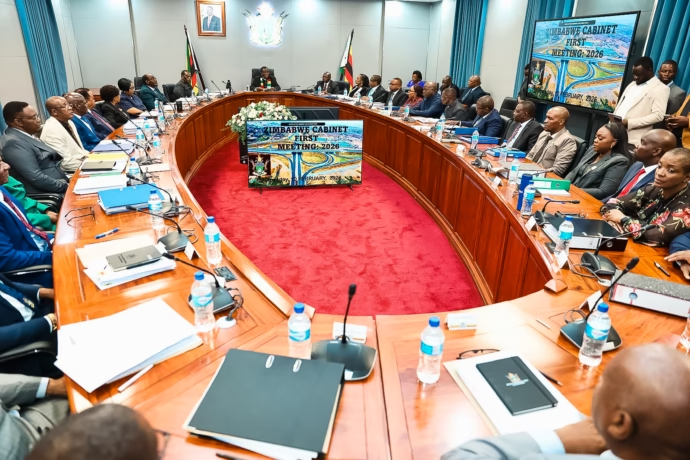
Book NowCabinet received an update report confirming that this year’s National Youth Day will be held on 21 February 2026 at Igava Training Centre in Marondera District, Mashonaland East Province, under the theme, Youth Agenda for Transformation. The rotating provincial hosting model continues, reinforcing Government’s decentralisation framework and regional development strategy.
At the centre of the celebrations is not only the commemorative gathering itself, but the establishment of a new state of the art Vocational and Youth Centre at Igava, which will be named in honour of His Excellency the President, President Emmerson Dambudzo Mnangagwa. The facility is designed to function as a long term skills, innovation and enterprise development hub rather than a symbolic structure tied only to the event.
From a development economics perspective, the Igava centre represents an infrastructure led youth empowerment model, where physical training ecosystems are built to close the gap between policy intent and labour market realities. Zimbabwe, like many developing economies, faces a youth employment challenge driven by demographic growth, skills mismatch and limited formal sector absorption. Institutional training centres linked to production, innovation and enterprise incubation are increasingly viewed as practical bridges between education and economic participation.
The planned facility will include smart workshops, metal fabrication units, digital learning laboratories, innovation and incubation hubs, demonstration farms, mining technical workshops, sports and recreation amenities, residential accommodation and health facilities. This multi sector design indicates a deliberate move away from narrow vocational tracks toward integrated capability development aligned with agriculture, mining, manufacturing and digital sectors.
The curriculum and training programmes are expected to be supported through Public Private Partnerships, a financing and governance approach that improves market relevance and reduces long term fiscal pressure on the State. PPP backed training models typically allow industry participation in curriculum design, equipment provision and placement pathways, increasing the probability that training outputs match industry demand.
Government expects approximately 30 000 youths from across all provinces to participate in the celebrations. While the number is symbolically significant, the deeper policy value lies in using the event as a mobilisation and onboarding platform into structured youth programmes, enterprise support systems and skills pipelines.
The targeted outcomes, enhancing employment opportunities, empowering young people, developing skills for youths not in education, employment or training, supporting youth owned enterprises and establishing a replicable model for Youth Service and Vocational Training Centres, align with broader national development priorities around productivity and inclusive growth.
Analytically, the success of this initiative will depend less on attendance figures and more on post event continuity, programme funding stability, private sector integration and measurable enterprise and employment outputs. If effectively implemented and replicated, the Igava model could evolve into a national network of youth production and innovation centres, strengthening Zimbabwe’s long term human capital base.
National Youth Day 2026 therefore stands not only as a commemorative date on the calendar, but as a policy instrument, linking youth recognition with infrastructure, skills formation and enterprise driven transformation.