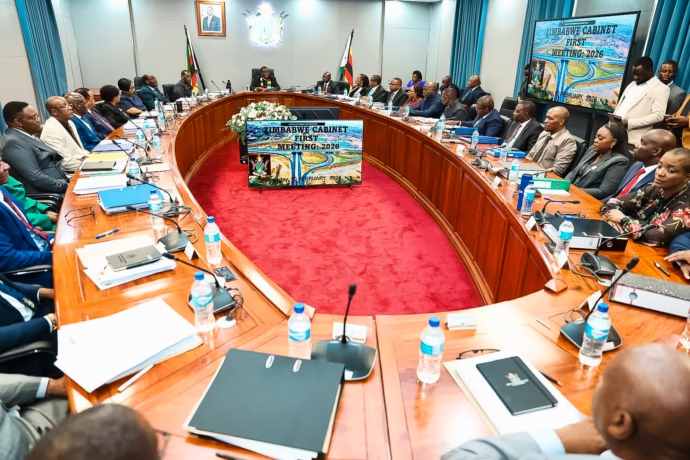


The Constitutional Amendment No. 3 Bill 2026 represents one of the most far-reaching proposed recalibrations of Zimbabwe’s constitutional framework since the adoption of the 2013 Constitution. Framed as a response to governance experience, developmental imperatives, and comparative constitutional practice, the Bill seeks to refine institutional design, consolidate authority, and prioritise stability and policy continuity within the State architecture.
At its core, the Bill is anchored on the premise that constitutional systems are living instruments. Rather than treating the Constitution as static, the proposed amendments advance the argument that effectiveness, resilience, and developmental responsiveness require periodic adjustment in light of practical governance realities.

Rainbow Hotels — Experience Luxury Across Zimbabwe
Rainbow Hotels continues to redefine hospitality standards in Zimbabwe, offering world-class accommodation, fine dining, and modern conference facilities in Harare, Bulawayo, and Victoria Falls.
Whether for business or leisure, Rainbow Hotels delivers unmatched comfort, exceptional service, and a truly premium guest experience tailored to modern travellers.
Book NowFrom a political economy perspective, the Bill’s overarching rationale emphasises stability as a prerequisite for development. By seeking to reduce electoral frequency, rationalise institutions and clarify mandates, the proposed reforms are positioned as mechanisms to minimise disruption, policy reversals, and institutional friction that often undermine long-term national programmes.
One of the most consequential provisions is Clause 2, which proposes the repeal of Section 92 and the introduction of a parliamentary process for electing the President. Under this model, the President would be elected by Parliament through a majority vote, with a run-off mechanism where an absolute majority is not achieved. Judicial oversight by the Chief Justice or a designated judge is intended to enhance procedural integrity, transparency, and constitutional accountability.
This proposal marks a fundamental shift in executive legitimacy, moving from direct popular election to a parliamentary mandate. Proponents may argue that such a system strengthens accountability between the executive and legislature, aligns leadership selection with parliamentary representation, and reduces the financial and social costs associated with nationwide presidential elections. Critics, however, are likely to interrogate its implications for direct democratic participation and popular sovereignty.
Clauses 3, 7, and 8 introduce another structural shift by extending the terms of office for the President and Parliament from five to seven years. The economic and governance logic advanced here is centred on policy continuity and reduced electoral disruption. In development planning terms, longer political cycles can provide governments with sufficient time horizons to implement complex infrastructure projects, industrial strategies, and institutional reforms without the constant pressure of election cycles.
However, the extension of terms also raises critical questions around democratic renewal, accountability intervals, and citizen oversight. The balance between stability and responsiveness becomes a central axis on which public debate around this amendment will likely turn.
Clause 5 addresses the institutional standing of the Attorney General by raising the qualification threshold from the High Court to the Supreme Court level. This amendment reflects an internal coherence argument, recognising that Deputy Attorneys General already operate at parity with High Court judges. By elevating the qualification standard, the Bill seeks to strengthen legal leadership, prosecutorial independence, and constitutional fidelity within the justice delivery system.
Clause 6 expands the Senate by allowing the President to appoint ten additional Senators, increasing the total from eighty to ninety. The stated objectives are to broaden technical expertise within Parliament, enhance oversight capacity, expand the pool of potential Ministers, and promote national cohesion. From an institutional design lens, appointed legislators can inject specialist knowledge into legislative processes, though this must be weighed against concerns over representational balance and executive influence.
Electoral governance is another major focal point of the Bill. Clauses 9, 10, and 11 establish a Zimbabwe Electoral Delimitation Commission, transferring the function of boundary delimitation from the Zimbabwe Electoral Commission to a standalone body. This reform is intended to address institutional overlap and perceived conflicts arising from ZEC’s dual mandate. By separating election administration from boundary delimitation, the Bill advances principles of functional specialisation, institutional integrity, and public confidence in electoral processes.
Further electoral reforms are contained in Clauses 12 and 16, which transfer voter registration, voter roll compilation and custody from ZEC to the Registrar General. The efficiency rationale is grounded in the Registrar General’s custodianship of civil registration data. Centralising these functions may improve data integrity and administrative efficiency, although it also concentrates sensitive electoral infrastructure within the executive branch, a factor that will invite scrutiny.
Clause 14 repeals provisions relating to judicial interview processes, signalling a shift in judicial appointment mechanisms. This amendment touches directly on judicial independence and transparency, and its implications will be closely examined by legal scholars and civil society.
Security sector governance is addressed in Clause 15, which amends Section 212 by replacing the phrase to uphold the Constitution with in accordance with the Constitution. While subtle in wording, the change is legally significant. It seeks to reinforce the hierarchical constitutional framework established under Sections 213 and 214, clarifying that defence forces operate strictly within constitutional authority rather than acting as autonomous constitutional guardians.
Perhaps the most institutionally consolidating proposal is found in Clause 17, which repeals Part 4 of Chapter 12 and dissolves the Zimbabwe Gender Commission, transferring its functions to the Zimbabwe Human Rights Commission. This move reflects an efficiency and coherence argument, consolidating human rights oversight under a single institution. Supporters may view this as reducing duplication and strengthening enforcement capacity, while critics may raise concerns about the dilution of focused gender advocacy within a broader human rights mandate.
Taken together, the Constitutional Amendment No. 3 Bill 2026 represents a deliberate re engineering of Zimbabwe’s governance framework, privileging stability, institutional consolidation and administrative efficiency. Its success or controversy will ultimately depend on how citizens, Parliament and stakeholders interpret the trade-offs between continuity and accountability, consolidation and pluralism, efficiency and democratic depth.
What is clear is that the Bill is not a minor technical adjustment, but a foundational proposal that seeks to reshape how power is organised, exercised, and legitimised within the Zimbabwean State.