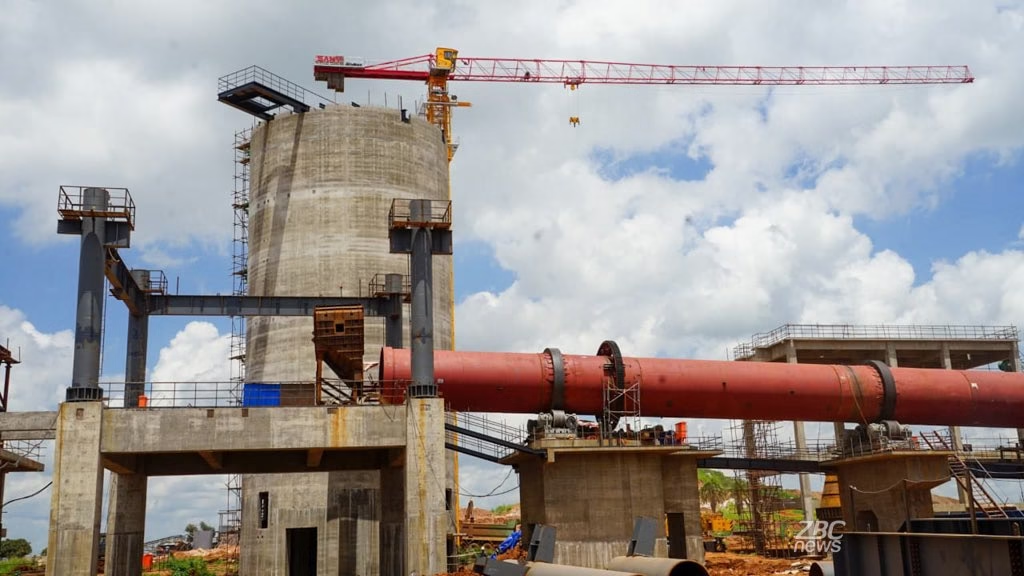
Zimbabwe’s cement market is being structurally reshaped, not merely supplemented, as the US$80 million Shuntai Investments cement plant in Chegutu moves toward commissioning by mid-year, injecting more than 800 000 tonnes into annual national output and directly confronting chronic supply shortages, import dependence and price volatility.
The scale and timing of the project matter. Cement is not a consumer good; it is an economic enabler. Its availability directly determines the pace and cost of housing delivery, road construction, energy infrastructure, irrigation works and industrial expansion. By materially expanding domestic capacity, the Chegutu plant positions itself as a pressure valve in a market long constrained by demand outstripping local supply.
Construction at the site has advanced beyond symbolic milestones. All major plant equipment is already on location, with installation progressing steadily, signalling that this is no speculative announcement but a near-term industrial activation. Once operational, the facility will rank among the country’s most modern, fully integrated cement plants, incorporating energy-efficient systems and environmentally conscious production processes in line with emerging ESG expectations within heavy industry.
Strategically, the project aligns with Vision 2030 and the Zimbabwe Industrial Reconstruction and Growth Plan, both of which identify construction materials as foundational inputs for national development. Without affordable, locally produced cement, industrialisation remains a policy ambition rather than a measurable outcome. This investment narrows that gap.
The economic spillovers are already visible on the ground. More than 300 jobs have been created during the construction phase, with further employment anticipated once production begins, alongside indirect benefits for transport operators, raw material suppliers, maintenance firms and local SMEs in Chegutu and surrounding districts. For a town often peripheral to large-scale industrial capital, the project alters its economic trajectory.
From a trade perspective, the plant strengthens Zimbabwe’s import substitution drive. Cement imports have historically surged during infrastructure booms, draining foreign currency and exposing the sector to external price shocks. An additional 800 000 tonnes of domestic capacity directly reduces that exposure while improving supply reliability for both public and private sector projects.
The Chegutu investment also reinforces the evolving Zimbabwe–China economic partnership, particularly in capital-intensive sectors such as manufacturing, mining and agriculture. Unlike extractive-only engagements, this project anchors value creation locally, embedding production, jobs and skills within the domestic economy.
In a region where infrastructure demand is accelerating, the Chegutu cement plant is not just expanding output, it is recalibrating the economics of construction. For policymakers, contractors and investors alike, the message is clear: Zimbabwe’s industrial base is no longer waiting, it is being built.