
By Aldridge Dzvene

Rainbow Hotels — Experience Luxury Across Zimbabwe
Rainbow Hotels continues to redefine hospitality standards in Zimbabwe, offering world-class accommodation, fine dining, and modern conference facilities in Harare, Bulawayo, and Victoria Falls.
Whether for business or leisure, Rainbow Hotels delivers unmatched comfort, exceptional service, and a truly premium guest experience tailored to modern travellers.
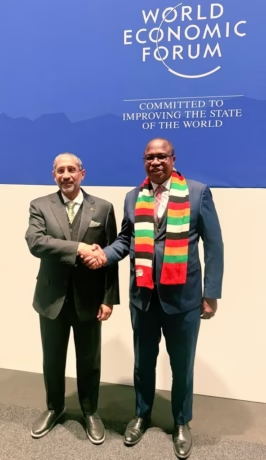
Book NowZimbabwe has chosen not to whisper its economic ambitions, but to place them squarely on the world’s most influential negotiating table, using the World Economic Forum in Davos as a strategic arena rather than a ceremonial gathering.
At the centre of this calculated move was the country’s chief envoy for international trade and foreign relations, Professor dr. Amon Murwira, who framed Zimbabwe’s participation not as diplomatic tourism, but as a deliberate incursion into spaces where global economic rules, capital flows and industrial futures are quietly shaped.
Unlike traditional diplomacy anchored in protocol and pleasantries, Zimbabwe’s engagement at Davos unfolded as an economic argument, that the country is no longer content with being spoken about in corridors, but insists on speaking for itself in rooms where decisions are made.
Murwira made it clear that Zimbabwe’s foreign policy has mutated into an economic instrument, one that trades handshakes for market access, and symbolic presence for measurable outcomes. In that logic, every bilateral meeting became a transaction of national interest, every dialogue a potential lever for domestic growth.
One of the clearest signals of this posture was Zimbabwe’s entry into talks with Gavi, the Global Alliance on Vaccines, not merely as a beneficiary seeking supplies, but as a country positioning itself within the pharmaceutical value chain, aiming to shift from import dependency to health-sector industrialisation.
Equally telling was the engagement with Philip Morris International, where the conversation was no longer about Zimbabwe as a raw tobacco exporter, but as a country demanding space higher up the value ladder. With projected output nearing half a billion kilogrammes this season, Zimbabwe is seeking not sympathy for farmers, but a structural reconfiguration of how its tobacco earns foreign currency.
Energy, often treated as a domestic headache, was elevated into a diplomatic currency, with Zimbabwe opening conversations with India and other partners on long-term generation, diversification and resilience. In doing so, Harare implicitly acknowledged that no industrial narrative can survive without an energy backbone.
What distinguishes Zimbabwe’s Davos posture is its refusal to separate trade from geopolitics, or economics from peace. Murwira argued that unfair trade regimes are not merely commercial distortions, but silent architects of instability, insisting that economic justice is a prerequisite for global order.
The country’s advocacy for reform within the World Trade Organization, therefore, was not rhetorical grandstanding, but a strategic insistence that Zimbabwe’s development cannot be hostage to outdated global economic hierarchies.
At an African level, Zimbabwe also inserted itself into conversations around the African Continental Free Trade Area not as a passive signatory, but as a state intent on using continental integration to industrialise rather than merely liberalise.
Perhaps most revealing was Zimbabwe’s quiet but deliberate presence in discussions on Africa’s future energy mix, including nuclear power, a subject few developing nations raise publicly, yet one that defines who will industrialise and who will remain peripheral in the coming decades.
Underlying all this is a foreign policy architecture deliberately redesigned under President Emmerson Dambudzo Mnangagwa’s economic diplomacy doctrine, where embassies are no longer extensions of protocol offices, but outposts of trade, investment and industrial strategy.
In this configuration, the Ministry of Foreign Affairs and International Trade is not a ceremonial institution, but a production line for national opportunity, where diplomacy is measured not by communiqués issued, but by factories built, jobs created and exports diversified.
Zimbabwe’s appearance at Davos, therefore, was not about visibility for its own sake. It was a declaration that the country is no longer content with reacting to global economic trends, it intends to negotiate them, shape them, and where possible, bend them in favour of its own development trajectory.
And in a world increasingly defined by economic competition rather than military confrontation, that posture may prove to be Zimbabwe’s most strategic export yet.