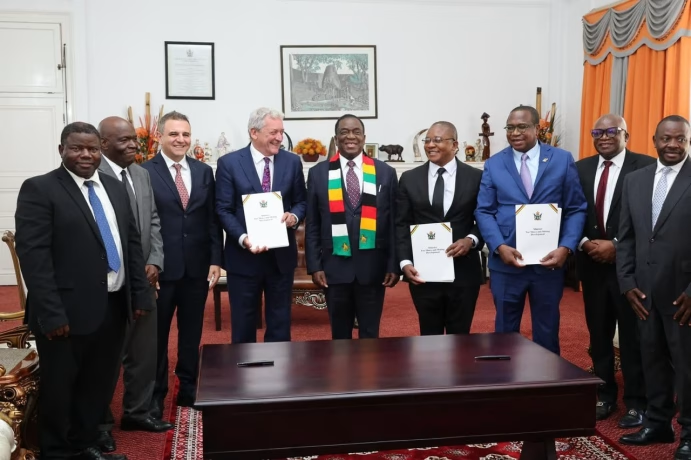
Zimbabwe’s 2026 National Budget has unexpectedly transformed economist Professor Gift Mugano and media platform ZFN Friday Drinks into the symbolic face of the Government’s ambitious 12 high-impact dam construction programme, not by formal appointment, but through public accountability, scrutiny, and national curiosity around the now-visible US$700 million infrastructure investment.
The spotlight follows Prof Mugano’s now-famous question on the fate of the US$700 million allocated toward dam construction in the 2025 National Budget, where he publicly asked where the dams were, a moment amplified by ZFN Friday Drinks across digital platforms. His challenge, which triggered wide national debate, framed the dams as “invisible infrastructure” and culminated in his bold declaration to “hunt for the dams.”
Ironically, the 2026 Budget has now positioned that same “hunt” as a national verification exercise, as Government rolled out a detailed update confirming that 12 strategic dams are under active construction across the country, anchoring Zimbabwe’s long-term water security, irrigation expansion, urban supply, and climate resilience.
Following Prof Mugano’s recent engagement with the Reserve Bank of Zimbabwe, where he gained deeper insight into monetary and fiscal coordination, a new national opportunity has emerged. The evolving alignment between economic commentators and the State now opens space for structured collaboration between the Ministry of Finance, ZINWA, Prof Mugano, and independent media platforms to translate budget figures into site-level public accountability.
Official documentation under the 2025 Zimbabwe Infrastructure Investment Programme, themed Building Resilience for Sustained Economic Transformation, clearly outlines water harvesting as a strategic economic pillar. While Gwayi Shangani and Kunzvi Dams were prioritised in 2025, Government confirms that active projects also include Ziminya, Semwa, Vungu, Mbada, Tuli Manyange, Dande, Bindura, Muswere, Musami, and Defe, bringing the full national matrix to twelve.
Among these, Gwayi Shangani Dam, set to become Zimbabwe’s third-largest inland water body, is now 73 percent complete, with its hydropower plant at 50 percent and the dam wall rising to 43 metres. Once completed, the dam is expected to revolutionise irrigation in Matabeleland, enable industrial growth in Bulawayo, and anchor livestock, mining, and power generation ecosystems.
Kunzvi Dam, Harare’s future strategic water lifeline, has reached 67 percent completion, with construction proceeding simultaneously on the dam wall, spillway, intake tower, and the 48-kilometre pipeline to Donnybrook. Unlike past projects where water infrastructure waited for auxiliary systems, this integrated approach ensures that water delivery begins immediately upon completion, reducing delays that have historically crippled urban water reliability.
Beyond water supply, the economic argument behind the dam programme is anchored in food security, irrigation-led agriculture, climate shock buffering, job creation, and rural industrialisation. Each dam becomes not just a storage facility, but an economic catalyst for farming blocks, fisheries, tourism nodes, and agro-processing zones.
Government’s vision is to complete the full dam network by 2027, positioning water as the backbone of Zimbabwe’s transition into an upper-middle-income economy. The realignment of fiscal planning toward water infrastructure reflects a deeper policy recognition that no meaningful industrialisation or agricultural transformation is possible without guaranteed water security.
Equally significant is the financing shift embedded in the programme. The Infrastructure Investment Plan confirms that, in line with the Integrated Approach to Water Development, Government will increasingly pursue private sector participation and cost-recovery models, particularly for commercially viable water supply schemes. This reduces long-term pressure on the fiscus while unlocking capital through bankable business models, PPPs, and user-based revenue systems.
In this evolving development story, Prof Mugano’s earlier skepticism has paradoxically strengthened the public legitimacy of the dam programme. What began as criticism has now matured into a national audit moment, a process where figures, concrete, spillways, pipelines, and wall heights are now physically verifiable.
The dams are no longer invisible. They are rising, in concrete, in hectares of irrigation, in megawatts, and in litres per second. And with that visibility comes a new standard for public infrastructure accountability, where questioning, transparency, and delivery now move in the same direction.