

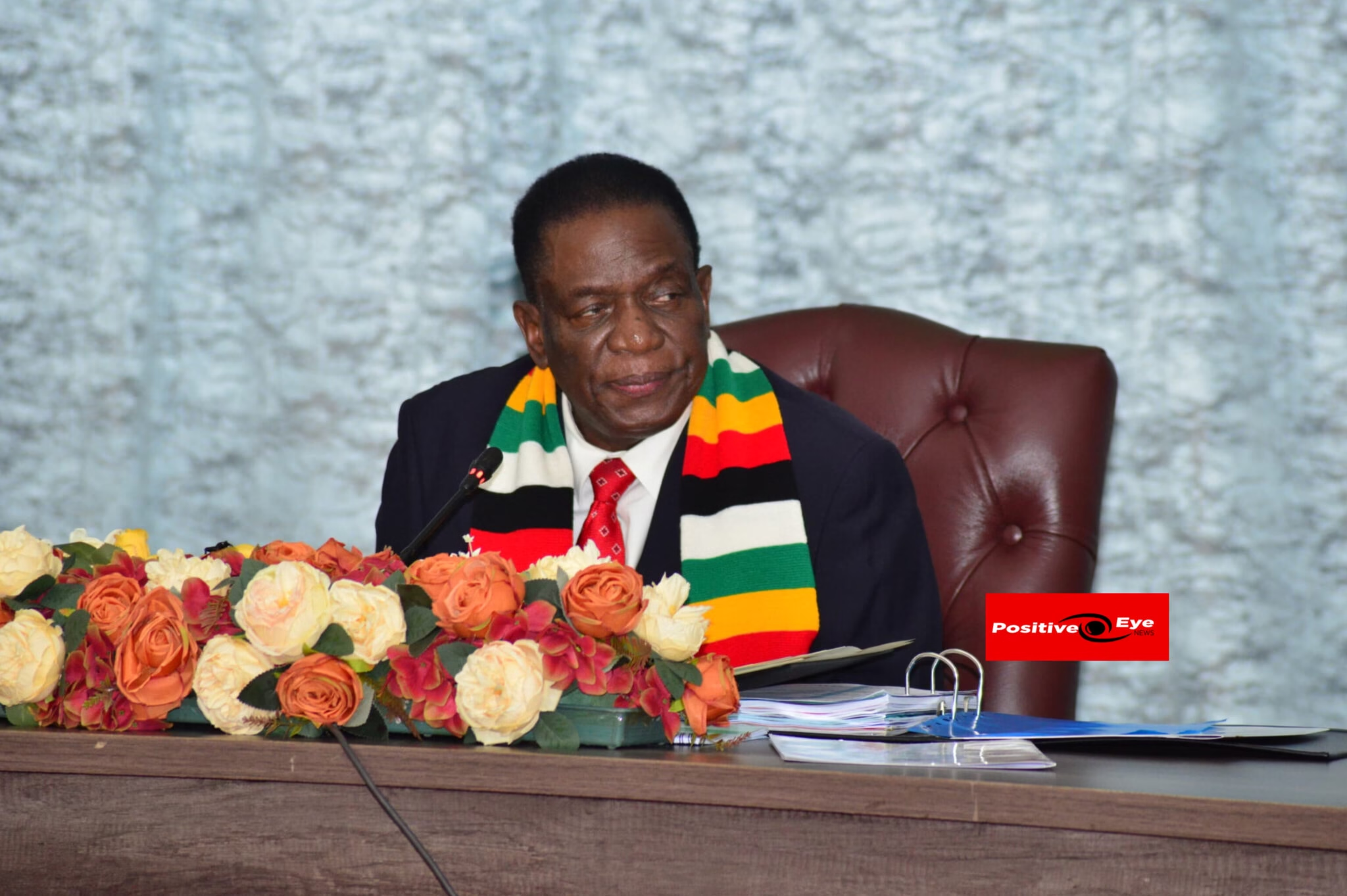
President Dr Emmerson Dambudzo Mnangagwa’s engagement and reengagement foreign policy doctrine has recorded one of its most significant breakthroughs yet, following the United States’ initiation of formal legislative processes to repeal the Zimbabwe Democracy and Economic Recovery Act ZDERA, a development poised to redefine Zimbabwe’s global economic standing after more than two decades of restrictions.
The move, now tabled before the United States House of Representatives under the Department of State Policy Provisions Act and sponsored by Florida Republican Representative Brian Mast, signals a historic policy shift in Washington’s posture towards Harare. If passed into law, the repeal will effectively remove legal barriers that have blocked Zimbabwe from accessing multilateral financial support from institutions such as the International Monetary Fund and the World Bank.
ZDERA, enacted in 2001, crippled Zimbabwe’s ability to secure balance of payments support, infrastructure financing, and debt relief, constraining national development and deepening socio-economic challenges. Over the years, the sanctions framework evolved from a political instrument into a direct impediment to livelihoods, industrial recovery, currency stability, and service delivery, with ordinary citizens bearing the heaviest burden.
Under the Second Republic, President Mnangagwa recalibrated Zimbabwe’s diplomatic compass through the engagement and reengagement thrust anchored on the principles of Nyika inovakwa nevene vayo, A friend to all and an enemy to none, and Zimbabwe is open for business. This posture gradually reopened diplomatic corridors that had remained frozen for years, replacing confrontation with dialogue, and isolation with strategic cooperation.
The United States’ reconsideration of ZDERA now reflects an implicit acknowledgement that punitive isolation did not yield the intended outcomes but instead weakened economic systems, distorted regional trade flows, and undermined broader geopolitical interests. The new approach signals a shift from coercive diplomacy to constructive engagement, recognising that sustainable reform and development are best achieved through partnership rather than pressure.
Beyond political symbolism, the repeal of ZDERA carries profound economic implications. It unlocks possibilities for renewed international credit lines, development finance, private sector confidence, and infrastructure investment at a time when Zimbabwe is aggressively pursuing industrialisation, agricultural transformation, and energy security under Vision 2030.
For Zimbabwe, this moment represents more than diplomatic victory, it marks the gradual dismantling of a sanctions architecture that had become entrenched in global financial systems. It also validates the Second Republic’s diplomatic strategy that prioritised sovereignty, economic reengagement, and mutual respect over rhetoric and dependency.
As Zimbabwe positions itself for accelerated economic recovery and regional value chain integration, the possible repeal of ZDERA stands as one of the clearest indicators yet that the global tectonic plates are shifting. Engagement, once resisted, is now emerging as the dominant diplomatic currency, and Zimbabwe is firmly back at the table.