By Aldridge Dzvene
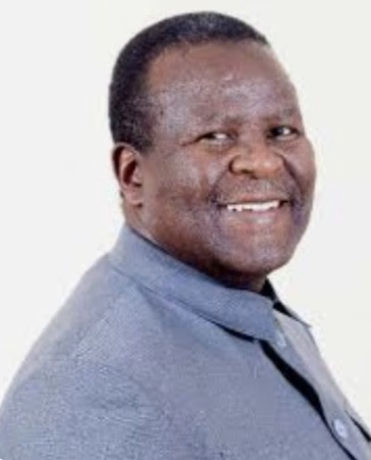
In Geneva, where global leaders gathered beneath the neutral light of diplomacy, Zimbabwe’s Speaker of Parliament Hon Advocate Jacob Francis Nzwidamilimo Mudenda broke through the usual rhetoric and called the world to a moral awakening. His address at the 151st Inter Parliamentary Union Assembly was not a ceremonial courtesy, it was a moment of reckoning. He spoke of humanity as if it were standing at the edge of its own conscience, warning that humanitarian law has become a ghost of its founding ideals, recited with solemnity but abandoned in practice.
The Assembly which brought together one thousand one hundred and fifty delegates from one hundred and thirty two countries concluded with the adoption of the Geneva Declaration on Upholding Humanitarian Norms and Supporting Humanitarian Action in Times of Crisis. It was an outcome that echoed Mudenda’s warning that international humanitarian law is not failing because it is outdated but because global leadership has allowed selective morality to corrode its meaning. His words carried weight not only because they were eloquent but because they were uncomfortable. He reminded the world that while parliaments deliberate, civilians die, and while resolutions are debated, the rules of war are violated in plain sight.
Mudenda’s tone was both scholarly and urgent. He wove law, ethics and politics into a single thread and then used it to expose the fragility of the global order. He spoke of the more than three hundred and fifty million people displaced by war, of hospitals bombed, of humanitarian workers killed, and of aid blocked by politics. He argued that neutrality in the face of injustice is not statesmanship but surrender. For him, parliaments must become the moral engine of nations, legislating with empathy and accountability when governments falter.
What made his intervention stand out was its intellectual confidence and its Pan African grounding. He presented Africa not as a continent of perpetual need but as a source of progressive legal thought. He cited the African Union’s Kampala Convention as a continental framework that embodies humane governance and the SADC Protocol on Politics Defence and Security Cooperation as proof that regional systems can uphold stability when global ones fail. Africa he said must be recognised not as a recipient of aid but as an architect of moral frameworks for the world.
The Zimbabwean delegation reflected this spirit throughout the Assembly. President of the Senate Hon Mabel Chinomona led the Forum of Women Parliamentarians in pushing for laws against illegal international adoptions rooted in gender discrimination. Young legislators Hon Nyelele Hon Nyevera and Hon Kademaunga pressed for youth inclusion in politics sharing Zimbabwe’s model of constitutional youth representation. Hon Chief Mtshane Lucas Khumalo spoke in the Standing Committee on Sustainable Development arguing for a fair global economy that resists protectionism and corporate tax evasion. Hon Nyevera joined the debate on Peace and International Security emphasising that transparency in defence spending is a democratic obligation not a privilege of the executive. Hon Karikoga presented Zimbabwe’s progress in climate action highlighting renewable energy investments and climate smart agriculture which have made Zimbabwe the first African country to update its Nationally Determined Contributions ahead of schedule.
The delegation’s coherence and thought leadership reflected a Parliament that understands diplomacy as an extension of national principle. It was not by chance that Hon Kademaunga was elected to the Working Group on Science and Technology where she contributed to deliberations on Artificial Intelligence digital transformation and cybersecurity governance. Nor was it incidental that Hon Nyelele and Hon Kademaunga helped the Standing Committee on United Nations Affairs move a historic motion recommending the election of the first woman Secretary General of the United Nations. The motion was adopted with applause signalling that gender equity is now a moral imperative not a symbolic gesture.
When the Geneva Declaration was adopted it carried traces of Mudenda’s influence. It reaffirmed the sanctity of the Geneva Conventions and called upon parliaments to ratify humanitarian treaties, allocate funding for aid agencies, and integrate humanitarian principles into national security policy. It reminded the world that humanitarian law only protects when nations honour it and that the rule of law is meaningless without the rule of conscience.
Yet beyond the resolutions, what lingered was the idea that Zimbabwe had spoken with clarity and authority in defence of humanity. Hon Advocate Mudenda’s private meetings with leaders such as Hon Thoko Didiza of South Africa, Hon Fatma Öncü of Türkiye, IPU Secretary General Mr Martin Chungong and SADC Parliamentary Forum Secretary General Ms Boemo Sekgoma reflected a deliberate reassertion of Zimbabwe’s diplomacy built on values not vanity.
The Assembly closed with applause and procedural announcements, but beneath the protocol there was a shift. The world had been reminded that in a century defined by conflict and climate, it is not military power that will save humanity but moral clarity. Mudenda left Geneva not as a participant who merely attended but as a statesman who unsettled indifference. His message was simple but profound, that parliaments must legislate for the soul of humanity and that silence before injustice will one day be recorded as the loudest betrayal of our time.