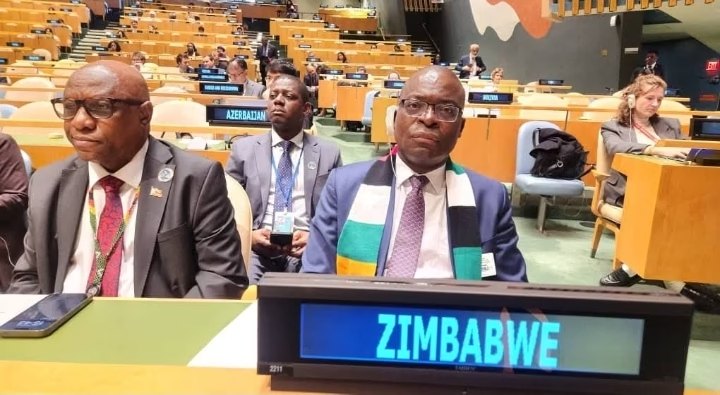
When President Emmerson Mnangagwa, through Foreign Affairs Minister Professor Amon Murwira, addressed the 80th Session of the United Nations General Assembly in New York, the message was clear: Zimbabwe wants a world order that truly reflects the voices of all nations, not just the powerful few.
The call was less about rhetoric and more about rebalancing international governance in favour of fairness. Zimbabwe’s emphasis on the need for the UN to revisit its founding principles points to an ongoing frustration in the Global South: the tendency for developing nations to be sidelined in major international decisions. By framing reform as “member state driven, inclusive and anchored in the principle of sovereign equality,” Harare positioned itself as both a critic of current imbalances and a proponent of multilateral renewal.
The intervention aligns Zimbabwe with a broader movement among developing countries that are demanding structural changes in global institutions. The reference to the Secretary General’s “UN 80” initiative was significant, showing an embrace of reform not as disruption but as an evolution necessary for legitimacy and effectiveness. For Zimbabwe, which has faced its own share of diplomatic isolation in past decades, this positioning underscores a desire to reclaim a constructive voice on the global stage.
But the speech also served a dual domestic purpose. By highlighting reforms and investment in agriculture, mining, tourism, and manufacturing, President Mnangagwa sought to frame Zimbabwe as a nation undergoing transformation, eager to show that internal progress mirrors its global aspirations. This blending of domestic reform and international diplomacy is strategic, linking the case for inclusivity at the UN with evidence of inclusivity and development at home.
The broader takeaway is that Zimbabwe is not just seeking a seat at the table, it is pushing for the reshaping of the table itself. In the context of shifting geopolitics, where emerging economies and blocs are demanding recognition, Zimbabwe’s message is timely. Whether global powers take notice remains to be seen, but the consistency of Harare’s call for fairness places it firmly within a chorus that is increasingly difficult to ignore.