By Aldridge Dzvene
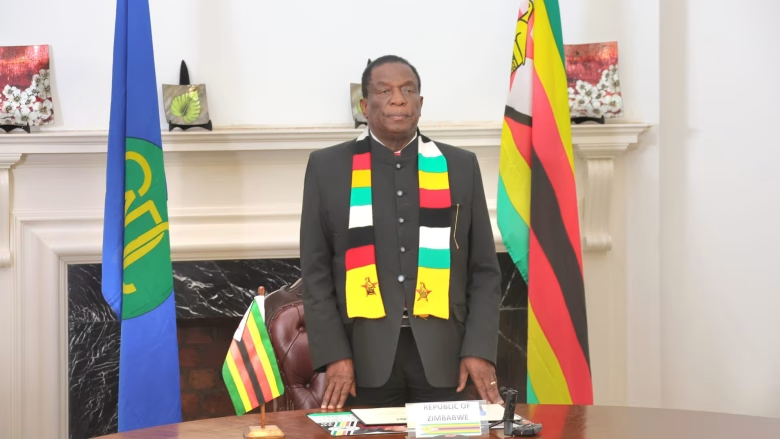
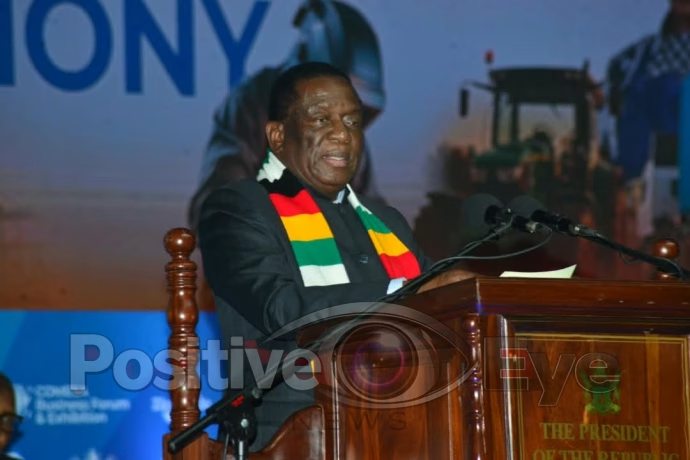
In Johannesburg, beneath the banner of unity and the echo of past struggles, a compelling call to ideological arms was delivered by the Southern African Development Community (SADC) Chairperson and ZANU PF First Secretary, His Excellency President Dr. Emmerson Dambudzo Mnangagwa. At the Liberation Movements Summit held in South Africa, President Mnangagwa did not merely speak to his peers, he invoked the collective memory of Africa’s liberation journey and pressed for a strategic revival of revolutionary politics to safeguard the future of the continent.
In a time of shifting global dynamics and increasingly subtle neo-colonial pressures, the summit became a necessary reckoning, a forum for the continent’s foundational political movements to reflect, reconnect, and regroup. Representing the six historic liberation parties, ZANU PF of Zimbabwe, ANC of South Africa, SWAPO of Namibia, FRELIMO of Mozambique, MPLA of Angola, and CCM of Tanzania, the gathering carried not only symbolic significance, but ideological urgency.
President Mnangagwa’s speech served as both compass and conscience for the summit. With the gravitas of a veteran freedom fighter, and the foresight of a statesman, His Excellency cautioned that the infrastructure of oppression, though outwardly dismantled, has re-emerged in cunning modern forms, through economic sabotage, political manipulation, foreign interference, and covert destabilisation. “The infrastructure that denied us democracy and independence has mutated,” he stated. “They express themselves in numerous forms… including interference in the internal affairs of our parties and governments.”
But rather than merely sounding alarm bells, His Excellency President Mnangagwa laid out a visionary roadmap, one steeped in historical legitimacy and rooted in practical sovereignty. His assertion was unflinching: liberation movements are the only credible stewards of Africa’s hard-won independence and the only dependable drivers of socio-economic transformation. “The responsibility and duty to build brighter and more prosperous countries for the next generations lies with us, the liberation movements,” he declared. “We are the only tried, trusted, and dependable drivers of socio-economic justice, development, and regional stability.”
There was no mistaking the weight of his words. It was not nostalgia, but necessity that underpinned his message. The summit, and by extension President Mnangagwa’s perspective, came at a time when external actors are intensifying efforts to penetrate African political ecosystems, not with tanks and bombs, but with policy manipulation, ideological dilution, and economic pressure cloaked in partnership. His Excellency’s call for unity, ideological clarity, and unwavering commitment to founding values was a direct rebuttal to these tactics. “We defeated them in the past,” he reminded the summit, “and we shall defeat them again, and again, and again.”
What makes His Excellency’s leadership in this summit particularly significant is the balance he struck between historical reverence and strategic foresight. While the liberation credentials of these movements remain unchallenged, the modern terrain demands agility, coordination, and re-education of younger generations who may not have lived the liberation struggle but are now entrusted with its legacy. In that context, President Mnangagwa’s insistence on “bold and purposeful synergies” and “responsive and honest exchange of ideas” becomes not just a call to preserve, but to evolve.
His Excellency’s stewardship as both Head of State and SADC Chairperson is increasingly defining a regional shift, one that views sovereignty not just as territory, but as control of ideology, economy, and narrative. And this summit was a strategic move to reinforce that outlook. It is a reminder that liberation movements must not fade into ceremonial relevance but must sharpen their strategies, modernise their governance models, and lead Africa through the contemporary struggles of digital colonisation, debt dependency, and political engineering by foreign powers.
By concluding with a firm reaffirmation of liberation values, independence, sovereignty, democracy, and equality, His Excellency President Mnangagwa reaffirmed what many in Africa’s revolutionary circles already know but often hesitate to declare: that the soul of Africa’s future lies in its memory, and that the unity of liberation movements is not a nostalgic club of old war comrades, but a frontline of resistance against modern conquest.
As the curtain fell on the summit, one thing was certain, the voice of His Excellency President Mnangagwa had not only resonated across the hall, but across a continent in search of ideological anchorage. Through his leadership, Zimbabwe continues to shape and inspire the continental discourse, not with borrowed voices, but with the voice of a people who remember, who resist, and who refuse to be ruled again.