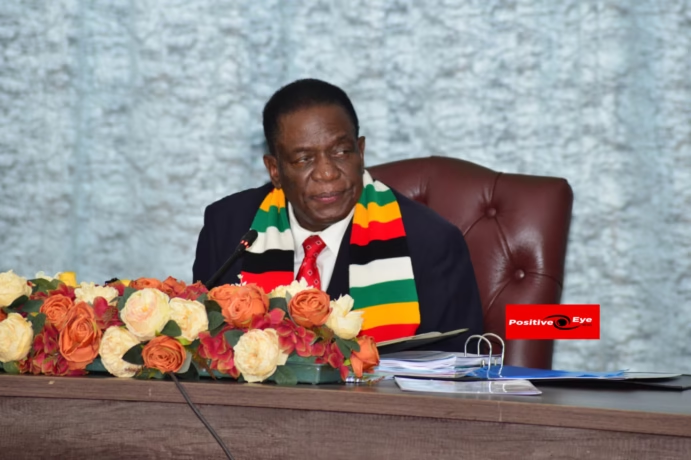
The launch of Zimbabwe’s new Media Policy at State House on 28 May 2025 was more than a ceremonial milestone. It was a declaration that Zimbabwe is prepared to take command of its narrative, fortify its sovereignty in the digital age, and construct a media landscape aligned with national development, cultural identity, and the demands of 21st-century information ecosystems.
President Emmerson Mnangagwa’s keynote address reflected the gravity of this moment, where media policy intersects with geopolitics, technology, economic justice, and the existential need to define who tells Zimbabwe’s story, and how. The Media Policy, in his framing, is not merely regulatory, it is restorative. It reclaims the right of Zimbabweans to see themselves not through imported lenses, but through a mirror grounded in Ubuntu, national values, and constitutional freedoms.
The President’s remarks were laced with urgency about global digital inequalities, how Artificial Intelligence, unregulated platform economies, and exploitative algorithms have reshaped media consumption in ways that threaten social cohesion, cultural identity, and fair market access. He warned that unfiltered exposure to unaccountable content from foreign platforms risks dislocating communities from their values while denying the local industry fair economic participation.
The new Media Policy places particular emphasis on content accountability, platform responsibility, and ethical journalism. It envisions a digital media ecosystem where local platforms thrive, creators are protected, and national stories are not drowned out by externally curated narratives. Provisions for fair taxation of global digital giants, digital literacy campaigns, and the strengthening of public service broadcasters signal a broader ambition: Zimbabwe wants to be digitally sovereign, not just technically connected, but culturally grounded and economically included.
Indeed, the policy’s alignment with Sections 61 and 62 of the Constitution reflects its balance, guaranteeing freedom of expression and access to information, while reinforcing responsibilities that come with those rights. This dual approach is deliberate. It seeks to empower but also to protect, in a world where misinformation, foreign influence, and hate speech can travel faster than the truth.
Importantly, the policy is not just urban or elite-focused. It reaches into communities, recognising the vital role of community radio and local content producers in shaping social dialogue and preserving indigenous knowledge. The President noted that 14 community radio stations have been licensed under the Second Republic, and more will receive capacity-building support to ensure their independence and sustainability. These local voices are seen as anchors of inclusion, connecting citizens to development agendas, cultural heritage, and local governance.
The digital transformation of legacy institutions like Zimpapers and ZBC reflects a broader state modernisation agenda. Through investments in content hubs, new media centres, and second-phase digitisation efforts in Bulawayo and beyond, Zimbabwe is positioning itself to participate competitively in the continental and global content economy. These are not just infrastructure upgrades, they are strategic recalibrations.
But the success of the policy will ultimately rest not on paper, but in practice. Will media houses embrace the challenge to tell stories of resilience, development, and African pride? Will creators resist the pull of viral sensationalism in favour of constructive national narratives? Will citizens reclaim their role not just as media consumers, but as conscious participants in shaping national discourse?
President Mnangagwa left no ambiguity about the stakes. In his vision, media must be a partner in development, not a platform for division. “Let us be patriotic and responsible,” he urged, reminding all present that information is power, and power must serve the people.
This policy, then, is more than a regulatory instrument. It is a nation-building document. A tool of cultural renewal. A framework for digital dignity. And a clear message to the world: Zimbabwe is not a blank canvas for external narratives, it is a living, breathing story authored by its own people.
As the country marches towards Vision 2030, the media is being summoned not just to report the transformation, but to help deliver it.