Sunday Mail
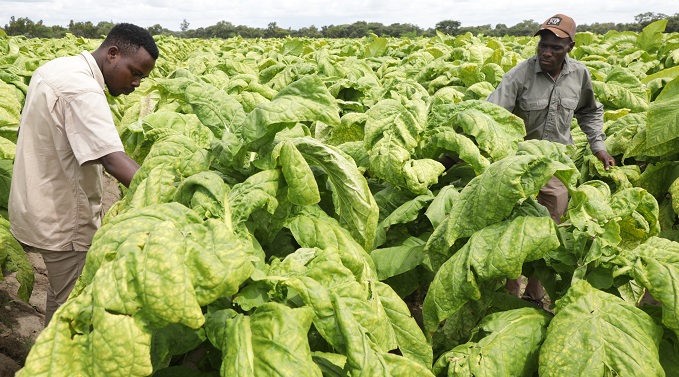
PARTS of the country are now expected to receive normal to above-normal rainfall over the next month, as the El Niño weather phenomenon, which threatened to cause a severe drought this season, is expected to weaken in intensity, raising hopes for a better-than-expected harvest in the 2023-4 summer cropping season.
This will bring relief to farmers who faced adverse weather, characterised by extreme heat and erratic rainfall during the first half of the cropping season last year.
During the first half of the rainy season, the weather phenomenon cast a dark shadow over the country’s agricultural prospects, raising fears of a severe drought and reduced crop yields.
The Government has, however, warned that the rainfall season will be “short and sharp”, urging farmers to stop planting.
Latest forecasts point to a substantial decline in El Niño’s intensity, with its strength set to subside over the next month.
Ministry of Lands, Agriculture, Water, Fisheries and Rural Development Permanent Secretary, Professor Obert Jiri said: “We have witnessed that there has been an increase in rainfall from December 24, with the country experiencing normal and above-normal rainfall.
“If there was a severe El Niño, we would not be experiencing this. This year’s El Niño phenomenon is based on a model that is not as severe as we had anticipated.
“So, yes, there is El Niño, but it is not as severe. It seems it is weakening, but that does not mean we are out of the woods yet.
“We expect that we are going to continue receiving rains, but they might end abruptly at the end of February into early March.
“We will have a short, sharp season.”
Farmers, he said, were being encouraged to stop planting despite the rains being received in some parts of the country.
“Those who had prepared should also consider short-season varieties since we have a short season,” he continued.
El Niño is a climate phenomenon involving the warming of the ocean surface temperatures in the eastern Pacific Ocean near the equator.
It often occurs in cycles, alternating with its cooler counterpart, La Niña.
El Niño can disrupt the usual regional weather patterns, leading to more unpredictable and extreme weather events.
Floods can follow droughts, and intense cyclones become more likely.
Experts say farmers accustomed to regular seasonal patterns may face challenges adapting to the altered rainfall and temperature fluctuations brought by El Niño, impacting agricultural production and food security.
Responding to questions from The Sunday Mail recently, Meteorological Services Department (MSD) head of forecast Mr James Ngoma said: “Humidity over Zimbabwe tends to increase in the months of December, January and March.
“Fortunately for Zimbabwe, this is coupled with cloudy and wet conditions. These rains tend to cool the daytime conditions over the areas they fall on. Thus, the next few months have a high probability of rains and cooler days.
“A few dry spells may also result in high daytime temperatures on odd days, but heatwaves are highly unlikely.”
He said rains may be erratic, especially in farming regions 4 and 5.
“So, rainfall is still expected at different intervals in different areas during this period.
“It should be noted, however, that the rains may be erratic, especially over natural regions 4 and 5 since we are in an El Niño season.
“It is advisable to note that the public should rely more on three-day and ten-day forecasts issued by the MSD.”
Climate expert and University of Zimbabwe lecturer Dr Walter Svinurai said farmers must climate-proof their production.
“El Niño itself is not climate change as people are describing it,” he said.
“It is a natural phenomenon, but its impacts and occurrences are now worsened by climate change.
“Although it is still early to consider this a good season, it is still a sparing drought year and a not full-blown drought per se.
“The relationship between El Niño and rainfall over Zimbabwe is misunderstood by many and most people are of the view that El Niño implies drought.”
Climate researcher Dr Shingirai Nangombe said: “El Niño is not climate change.
“A closer analysis of the past 21 El Niño years in relation to Zimbabwe rainfall was undertaken; it is quite interesting to note that out of the 21 El Niño years which occurred in the past 60 years, eight (38 percent) had above-normal rainfall, while 13 (62 percent) had below-normal rainfall.
“These statistics clearly show that the eight episodes where above-normal rainfall was received during an El Niño episode explain that the El Niño episode and below-normal rainfall is not a one-one relationship.
“Lastly, it is important to note that the worst meteorological drought was experienced during the 1991-92 summer rainfall season, which was not even an El Niño episode.”