

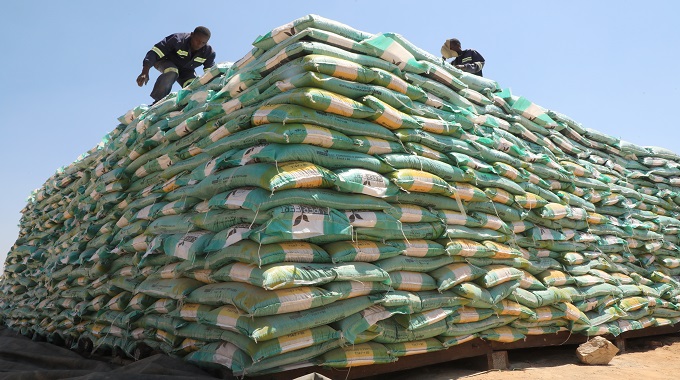
OVER 10 000 tonnes of seed have been distributed to farmers under the climate-proofed Presidential Inputs Scheme (Pfumvudza/Intwasa), accounting for 75 percent of the targeted allocation.
Grain Marketing Board (GMB) chief executive officer Dr Edson Badarai told The Sunday Mail that distribution of inputs will be concluded before the onset of the rainy season.
“Over 75 percent of the inputs have been distributed so far,” said Dr Badarai.
“The inputs are sufficient to cover all the Government-supported agricultural schemes, in line with the mantra of living no one and no place behind.”
By Friday, he said, 10 118 tonnes of seed had been handed over to farmers, with maize seed accounting for 8 220 tonnes, while sorghum seed accounted for 1 689 tonnes.
Soya bean seed makes up the rest.
“In addition, 65 589 tonnes of fertiliser, including 44 765 tonnes of Compound D and 19 824 tonnes of Ammonium Nitrate, have been released,” he added.
To ensure transparency during distribution, Mr Badarai said, Government has set up localised ward committees.
“Traditional leaders and AARDS (Agricultural Advisory and Rural Development Services) officers are overseeing the distribution of the inputs to curb corruption.
“So far this year, 28 accused persons have been arrested for cases involving the Presidential inputs,” he said.
Director of training and information in the Ministry of Lands, Agriculture, Fisheries, Water and Rural Development Mr Sibangilizwe Dlodlo said 3,4 million households had undergone conservation agriculture training.
“Nationally, we are targeting 3,5 million households, but even if the target is surpassed, we will make sure everyone gets the support to produce for the nation,” he said.
“Inputs are being given to farmers who will have dug holes, and some farmers are not yet ready, hence they cannot be given inputs.
“We are encouraging farmers to practise the tenets of the climate-smart agriculture model.”
Zimbabwe Commercial Farmers Union president Dr Shadreck Makombe said some farmers had already planted with the first rains experienced in parts of the country last week.
With the El Niño weather phenomenon expected to affect Southern Africa, Government has since adopted a new seed distribution method based on agro-ecological regions.
Farmers in drier regions — 4 and 5 — will receive drought-tolerant traditional grains seed, while those in region 3 will get seed for traditional grains and maize.
Farmers in high-potential areas such as regions 1 and 2 will be receiving high-yielding maize varieties and traditional grains, in addition to soya bean and sugar bean seed.
The authorities have also encouraged farmers to harvest rainwater throughout the season in anticipation of a mid-season dry spell.
Government has set a target of putting over three million hectares under crops in the 2023/2024 summer cropping season, with over two million hectares being set aside for maize
Sunday Mail
Positive Eye News