GOVERNMENT has suspended duty on fertiliser for approved and regulated importers for a 12-month period, with the Lands, Agriculture, Fisheries, Water and Rural Resettlement minister tasked to ensure that approved fertiliser importers adhere to responsible pricing of fertilisers.
Failure to adhere to set import parameters will attract penalties.
The bold move is to ensure there is adequate fertiliser in the 2023-2024 farming season and bolster the country’s food security.
According to the latest extraordinary Government Gazette published on Tuesday, Minister of Finance, Economic Development and Investment Promotion, Professor Mthuli Ncube said the regulations are in terms of Section 235 as read with Section 120 of the Customs and Excise Act for 12 months.
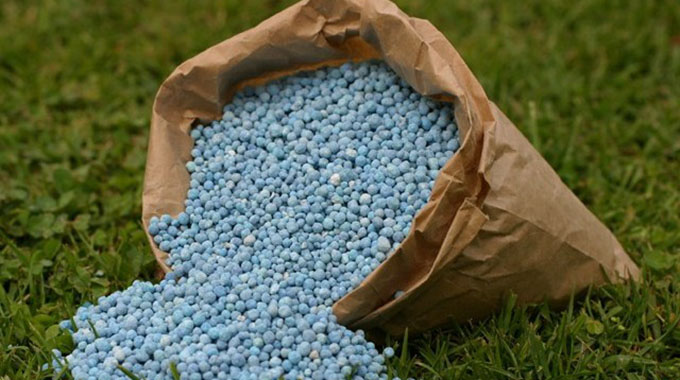
Fertiliser
“The Customs and Excise (Suspension) Regulations, 2003, published in Statutory Instrument 257 of 2003 are amended by the repeal of Section 9(T) (Suspension of duty on fertilisers imported by approved importers) and substitution with the following—
“Suspension of duty on fertiliser imported by approved and regulated importers. With effect from the date of publication of this notice and up to a period of twelve months, duty is wholly suspended on fertilisers imported by approved and regulated importers in terms of these regulations
“In these regulations, ‘approved fertiliser imported’ means any importer approved and licensed by the Ministry responsible for Agriculture, in consultation with the Ministry responsible for Industry and Commerce and the Fertiliser Manufacturing Industry to import fertilisers in quantities not exceeding the tonnage specified in the Schedule,” reads part of the notice.
It added: “The Minister responsible for Agriculture shall approve a list of reputable fertiliser importers for the purposes of these regulations. The Commissioner shall grant suspension of duty to an approved importer subject to compliance with Section 34C of the Revenue Authority Act [Chapter 23:11).”
Prof Ncube said the Commissioner shall not grant suspension of duty to an approved fertiliser importer where the importer does not have a licence issued by the Ministry responsible for Agriculture.
To that end, the Ministry responsible for Agriculture shall ensure that approved fertiliser importers adhere to responsible pricing of fertilisers for which the Commissioner would have wholly suspended duty payable.
“Any approved fertiliser importer who sells fertilisers for which duty would have been suspended at prices equal or higher than fertilisers on which duty is ordinarily payable shall be liable to pay duty suspended and applicable penalties.
“Notwithstanding the quantities specified in the Schedule. Approved importers shall be allowed to exhaust the ring-fenced allocations specified in Statutory Instrument 31 of 2023.”
According to the notice, the quantity of fertiliser eligible for suspension of duty for the summer crop 2023/2024 season include urea whether or not in aqueous solution and mixtures of urea and ammonium nitrate in aqueous or ammoniacal solution.
Ammonium nitrate, whether or not in aqueous solution and ring-fenced allocations are in the 100 000 and 150 000 tonnes range.
Last week, the Government announced that it has set aside over US$600 million for the 2023/24 farming season while the Bankers Association of Zimbabwe has committed $68 billion and US$160 million as the Second Republic steps up efforts to boost food security.

Money – Image taken from Pixabay
All the 460 irrigation schemes across the country will be put under irrigation during the summer cropping season to complement the Intwasa/Pfumvudza programme which is aimed at increasing yields in the face of the looming El Nino.
Weather experts have predicted a normal to below normal rainfall in most parts of the country and farmers have been encouraged to make sure they harvest water to mitigate against the effects of poor rains.
The three zones (Region 1, 2, and 3) will have a higher probability of receiving normal to below normal rainfall for most of the sub-seasons that make the period October 2023 to March 2024.
The rainfall is expected to be erratic in space and time, with violent storms, prolonged dry spells, flash floods and tropical cyclones as the season progresses.
Zimbabwe is an Agrarian economy with most of the country’s sectors being directly and indirectly linked to the agricultural sub-sector.
Zimbabwe envisages to be an upper middle-income economy by 2030 and agricultural production is critical in the attainment of that vision.
Chronicle