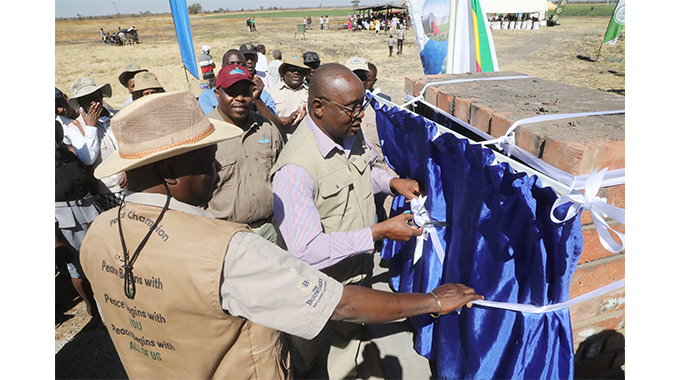
GOVERNMENT has completely transformed the lives of villagers in Ward 9 under Umguza District in Matabeleland North following the establishment of a 30-hectare irrigation scheme in Redwood, which was commissioned yesterday.
This comes as the Second Republic has made food security a top priority and is working towards a US$8,2 billion agriculture industry economy, contributing 20 percent of GDP by 2025 underpinned by the country’s National Development Strategy 1 (NDS1) — the driver towards Vision 2030 to make Zimbabwe an upper middle-class economy.
The irrigation scheme is benefitting 24 families. All activities are anchored on value addition and the villagers are now planning to set up a bakery where they will produce bread for sale to local shops and villagers in line with the rural industrialisation agenda.

Money – Image taken from Pixabay
Through rural industrialisation, the Government hopes to stem rural-to-urban migration.
Rural industrialisation, which is supported by the Second Republic’s devolution policy, involves nurturing agro-processing start-up enterprises in rural areas through financial and technological support via venture capital funding and Government agencies.
The Redwood Irrigation Scheme is equipped with a centre pivot. Lands, Agriculture, Fisheries, Water and Rural Development Deputy Minister Davis Marapira, who is responsible for Agricultural Colleges, Water Resources, Irrigation Development, Water, Sanitation and Hygiene commissioned the irrigation scheme.
The latest development has brought smiles to beneficiaries who could not hide their excitement as they celebrated.

Deputy Minister Davis Marapira
“Our lives have changed completely as a result of the assistance from Government. We are expecting a good harvest from the 25 hectares that is under winter wheat. We are looking forward to harvesting five tonnes per hectare” said Mr Alick Mpofu
Another plotholder, Mrs Siphiwe Makhwelo, said in the past she could not meet her financial needs including paying school fees for her children.
“This irrigation has improved our livelihoods as we are now able to sell our crops to raise money to fend for our families. I am now able to pay school fees for my children. We have plans to set up a bakery here where we will produce bread and buns to supply local shops,” she said.
In his address, Deputy Minister Marapira said Zimbabwe’s economy is anchored on the agricultural sector which contributes between 12 and 17 percent to the country’s Gross Domestic Product.

He said since the advent of the Second Republic led by President Mnangagwa, a raft of policy, strategic and legislative interventions to guide the transformation of the agriculture sector have been implemented.
“Since the launch of the Agriculture and Food Systems Transformation Strategy, heightened stakeholder engagements were made while much-needed sector leadership was provided to accelerate agricultural transformation in both space and pace dimensions,” said Deputy Minister Marapira.
“Resultantly, much was achieved, including a record wheat harvest of 375 131 tonnes in the just ended season and the introduction and subsequent consolidation of the climate-proofing agenda in 2021.”
Deputy Minister Marapira said the agriculture sector grew by 36 percent when the country produced a record maize crop of 2,7 million tonnes.
“One of the key deliverables of the blueprint is agricultural production and productivity to ensure food security. The agricultural sector is expected to improve food self-sufficiency from 45 percent in 2020 to 100 percent by 2025 thus ending hunger in Zimbabwe,” he said.
“This entails increasing food crop production beyond the levels of self-sufficiency at a national and household level.”
Dep Minister Marapira said as a result of the gains from the past two seasons, Zimbabwe is now on the path to regaining its status as the bread basket of southern Africa.

RedWood Irrigation Scheme
“As we work hard to deliver the National Development Strategy 1 and the Agriculture and Food Systems Transformation Strategy which is part of the roadmap to attaining vision 2030, Zimbabwe’s agriculture sector has, in the last decade, experienced changes in its climatic conditions,” he said.
“Rainfall patterns are no longer reliable for the agricultural sector with most parts of the country experiencing a late start to the summer cropping season. This has subsequently negatively affected efforts by the country’s agricultural sector to achieve national food security and yet about 70 percent of our people rely on agriculture as a source of livelihood.”
Deputy Minister Marapira said in response to the effects of climate change, Government is focusing on expanded irrigation development, dam construction and water harvesting to climate-proof agricultural production and enhance agriculture production.

Government, said Deputy Minister Marapira, plans to expand irrigation capacity from 150 000 hectares in 2019 to 350 000 hectares by 2025.
“This will be done across the country to safeguard the country against the vagaries of climate change and ensure national food security. President Mnangagwa is on record saying the Second Republic will not leave anyone behind as it marches towards the attainment of Vision 2030,” he said.
Deputy Minister Marapira said the rehabilitation of Redwood Irrigation Scheme is expected to uplift the livelihoods of farmers.

“However, this can only be achieved by focusing on improved production, productivit and taking farming as a business.
This will in turn enhance income, increase opportunities for value addition and the development of agribusiness value chains,” he said.
Chronicle