

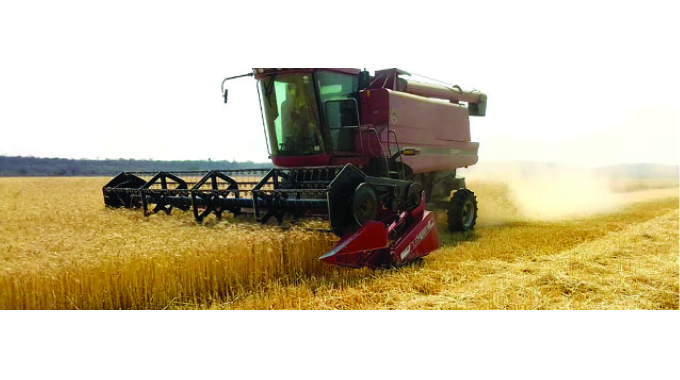
MATABELELAND South Province has put 3 300 hectares under wheat this winter against a target of 3 200 hectares with projected output of 16 500 tonnes.
Last year the province planted 2 286 hectares under the crop which is mainly grown at Arda Antelope Estate in Matobo and Arda Ingwizi Estate in Mangwe. There are also some irrigation schemes across the province, which were recently rehabilitated and have contributed to an increase in area planted.

Rainbow Hotels — Experience Luxury Across Zimbabwe
Rainbow Hotels continues to redefine hospitality standards in Zimbabwe, offering world-class accommodation, fine dining, and modern conference facilities in Harare, Bulawayo, and Victoria Falls.
Whether for business or leisure, Rainbow Hotels delivers unmatched comfort, exceptional service, and a truly premium guest experience tailored to modern travellers.
Book NowImproved power supply has also improved wheat production in irrigation schemes across the province. Schemes like Guyu-Chelesa Irrigation, which recorded a poor harvest last year due to power cuts are expecting improved yields.
Arda Antelope Estate has put 545 hectares under winter wheat with an expected output of seven tonnes per hectare. Zimbabwe produced 375 000 tonnes of wheat in 2022, above national demand of about 360 000 tonnes. This year the country is focused on increasing production to 408 000 tonnes.
Last year’s production made Zimbabwe and Ethiopia the only two wheat-secure nations on the African continent.
Locally, farmers are responding to Government’s initiatives as they ramped up preparations for the farming season.

Mr Mkhunjulelwa Ndlovu
In an interview, Matabeleland South acting provincial agricultural director rural development services, Mr Mkhunjulelwa Ndlovu, said they were expecting an improved yield this year as farmers planted early. He said the expected average yield per hectare is five tonnes.
“The province has 3 320 hectares under wheat this year and most of the crop is at vegetative stage or early flowering stage. The wheat, which was planted early in April and is now at flowering stage,” he said. “We expect harvesting to start in of October. This year we don’t expect our yield to be affected by rains like last year because farmers were able to plant early.
“The crop is good and we expect it to remain that way because of improved power supply. Last year production in some irrigation schemes such as Guyu-Chelesa Irrigation Scheme was affected by power cuts. The scheme is powered by electricity. Farmers are really happy and they are looking forward to a good harvest as the conditions are favourable to them.”
Guyu-Chelesa Irrigation Scheme member and former chairperson, Mr Gifford Moyo, said they were relieved as their crop was doing well because of improved power supply. He said they have 32 hectares under winter wheat. Mr Moyo said they were looking forward to selling their wheat to the Grain Marketing Board (GMB).
“Last year we failed to meet our target as a scheme because of power cuts. This year the supply has greatly improved and our crop is doing well. We are looking forward to an average yield of 4,5 to five tonnes. This will help us to sell to GMB and contribute significantly in feeding the nation,” he said.
Zimbabwe is optimistic that this year’s winter wheat production will surpass last year’s yield of 375 000 tonnes following various interventions implemented by the Government and the private sector to bolster production. In addition to local initiatives to support production, Zimbabwe received a chunk of the US$25,5 million African Development Bank (AfDB) to boost wheat and food production and avert food shortage.
Speaking recently during a visit to Arda Antelope Estate, Lands, Agriculture, Fisheries, Water and Rural Development Deputy Minister Davis Marapira, who is responsible for Agricultural Colleges, Water Resources and Irrigation Development, Water, Sanitation and Hygiene urged farmers to adopt modernised farming methods to record high yields. He said the Government will continue supporting farmers under the Presidential Scheme to ensure maximum yields.
Deputy Minister Marapira said the target was for the country to export wheat next year and this could be achieved through good agronomic practices. He said forex generated from wheat exports will stabilise the gross domestic product and increase the employment capacity and raw materials for industries.
Launching the National Development Strategy 1 (NDS1) in November 2020, President Mnangagwa said under the five-year Government economic blueprint, all sectors of the economy are obliged to increase their productivity.
Under the NDS1, more resources and greater momentum are being injected towards dam construction and efficient irrigation systems. The Second Republic has made food security a top priority and is working towards a US$8,2 billion agriculture industry economy, contributing 20 percent of gross domestic product by 2025, underpinned by the country’s NDS1 the driver towards Vision 2030 to make Zimbabwe an upper-middle income economy.
Efforts being made by the Second Republic will cumulatively see the country achieve the US$8,2 billion agriculture sector economy.
Chronicle


